
Cuvillier Verlag GmbH



| Areas | |
|---|---|
| Serie de libros (99) |
1418
|
| Nachhaltigkeit |
3
|
| Gesundheitswesen |
3
|
| Letra |
2417
|
| Ciencias Naturales |
5433
|
| Ciencias Ingeniería |
1825
|
| Ingeniería | 292 |
| Ingeniería mecánica y de proceso | 875 |
| Ingeniería eléctrica | 701 |
| Mineria y metalurgía | 30 |
| Arquitectura e ingeniería civil | 76 |
| General |
97
|
|
Leitlinien Unfallchirurgie
5. Auflage bestellen |
|
Erweiterte Suche
Impresion
EUR 98,40
E-Book
EUR 68,90
Discrete-Element-Based Simulation and Reduced-Order Modeling of Pharmaceutical Roller Compaction (Volumen 35) (Tienda española)
Christian Eichler (Autor) ORCIDPrevio
Lectura de prueba, PDF (880 KB)
Indice, PDF (660 KB)
In early-stage drug development, only a few grams of active ingredient are typically available, far too little for production trials on an industrial scale. Process design for dry granulation via roller compaction must therefore rely on small-scale trials and predictive models rather than extensive experiments.
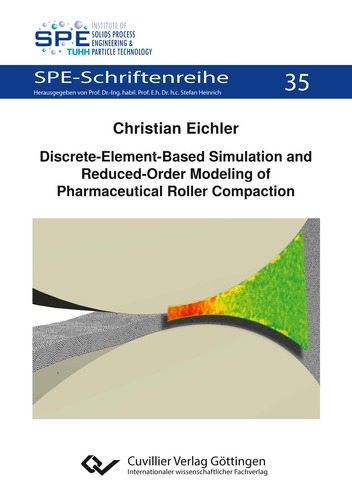
This dissertation traces the path of the powder along the entire process chain, from roller compaction through grinding to the finished tablet. Discrete-element simulations using a cohesive contact model, supported by particle tracking and μCT measurements, show how stress, particle motion, and ribbon porosity develop between the rollers. They show that the highest stress occurs slightly before the narrowest gap, where the material moves briefly faster than the roller surface. A simulation-based fracture model then describes the granules after grinding in a two-dimensional size-porosity distribution and reproduces the bimodal particle sizes observed in experiments. Finally, a compact reduced-order model predicts tablet porosity and tensile strength directly from the process parameters. With only two machine-specific correction parameters, it proved to be accurate for two excipients with very different compaction behaviors, mannitol and MCC.
Because these methods require only a small number of calibration tests, they reduce the experimental workload and support early-stage process and formulation decisions when materials are in short supply.
| ISBN-13 (Impresion) | 9783689526269 |
| ISBN-13 (E-Book) | 9783689526276 |
| Formato | B5 |
| Idioma | Inglés |
| Numero de paginas | 176 |
| Laminacion de la cubierta | mate |
| Edicion | 1. |
| Serie | SPE-Schriftenreihe |
| Volumen | 35 |
| Lugar de publicacion | Göttingen |
| Fecha de publicacion | 06.10.2026 |
| Clasificacion simple | Tesis doctoral |
| Area |
Allgemeine Verfahrenstechnik
|
| Palabras claves | Roller compaction, Pharmaceutical dry granulation, Discrete Element Method (DEM), Reduced-order modeling, Powder compaction, Pharmaceutical manufacturing, Continuous manufacturing, Granulation, Tableting, Powder mechanics, Granular materials, Compaction stress, Porosity, Ribbon porosity, Particle dynamics, Particle velocity, Cohesive contact model, DEM calibration, Bonded-particle model (BPM), Comminution, Screen milling, Breakage modeling, Particle size distribution, Granule size distribution, Porosity–size distribution, Micro-computed tomography (µCT), Particle tracking, Model validation, Johanson model, Kawakita model, Ryshkewitch–Duckworth model, Tablet porosity, Tablet tensile strength, Specific compaction force, Powder flowability, Pre-compaction, Microcrystalline cellulose (MCC), Mannitol, Process modeling, Pharmaceutical process development |


