
Cuvillier Verlag GmbH


| Areas | |
|---|---|
| Serie de libros (99) |
1415
|
| Nachhaltigkeit |
3
|
| Gesundheitswesen |
3
|
| Letra |
2413
|
| Medienwissenschaften | 17 |
| Teología | 57 |
| Filosofía | 103 |
| Derecho | 430 |
| Economía | 864 |
| Ciencias sociales | 423 |
| Ciencias del deporte | 48 |
| Psicología | 233 |
| Educación | 190 |
| Historia | 194 |
| Arte | 111 |
| Ciencias culturales | 168 |
| Literatur | 119 |
| Lingüística | 91 |
| Ciencias Naturales |
5430
|
| Ciencias Ingeniería |
1822
|
| General |
97
|
|
Leitlinien Unfallchirurgie
5. Auflage bestellen |
|
Erweiterte Suche
E-Book
EUR 25,70
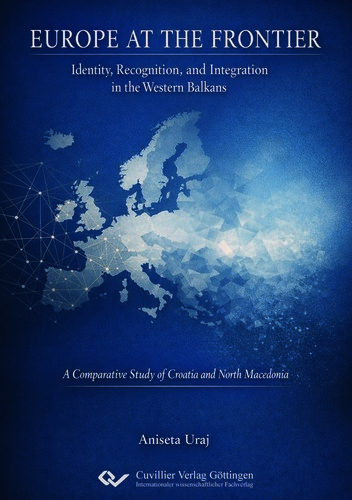
EUROPE AT THE FRONTIER: IDENTITY, RECOGNITION, AND INTEGRATION IN THE WESTERN BALKANS (Tienda española)
A Comparative Study of Croatia and North Macedonia
Aniseta Uraj (Autor) ORCIDPrevio
Lectura de prueba, PDF (130 KB)
Indice, PDF (2,8 MB)
The question of European identity remains a key issue in debates on European integration. While economic and legal integration have progressed significantly, the development of a shared political and cultural identity across Europe is still contested. This challenge becomes especially relevant in the context of the Western Balkans, a region historically shaped by diverse empires, religions, and political systems and often seen as Europe’s frontier.
The integration of the Western Balkans into the European Union carries not only institutional and economic implications but also symbolic and identity-related ones. It raises important questions about belonging, the limits of Europe, and how societies on its periphery relate to the idea of European unity.
This study focuses on the relationship between European identity, recognition, and integration in the Western Balkans, with particular attention to Croatia and North Macedonia. It argues that although European integration provides institutional structures and incentives, the internalisation of European identity varies and is influenced by historical experiences, national narratives, and perceptions of recognition.
The analysis is divided into two parts: first, it examines the conceptual links between European and Balkan identities, highlighting processes of inclusion and exclusion; second, it analyses how Europeanisation policies interact with national perspectives in the two countries. By comparing Croatia, an EU member state, with North Macedonia, a candidate country, the study shows how different stages of integration shape public attitudes toward Europe.
| ISBN-13 (E-Book) | 9783689524944 |
| Formato | A5 |
| Idioma | Inglés |
| Numero de paginas | 107 |
| Edicion | 1. |
| Lugar de publicacion | Göttingen |
| Fecha de publicacion | 25.03.2026 |
| Clasificacion simple | Libro de divulgacion |
| Area |
Etnología alemana y europea
|
| Palabras claves | European identity, Western Balkans, European integration, North Macedonia, EU enlargement, National identity, Croatia, Public perception, Europäische Identität, Westbalkan, europäische Integration, Nordmazedonien, EU-Erweiterung, nationale Identität, Kroatien, öffentliche Wahrnehmung, Europe, Politics, EU membership, Identity formation, Regional diversity, Europa, Politik, EU-Mitgliedschaft, Identitätsbildung, Regionale Vielfalt |


