
Cuvillier Verlag GmbH



| Fachbereiche | |
|---|---|
| Buchreihen (99) |
1414
|
| Nachhaltigkeit |
3
|
| Gesundheitswesen |
3
|
| Geisteswissenschaften |
2408
|
| Naturwissenschaften |
5428
|
| Mathematik | 229 |
| Informatik | 320 |
| Physik | 982 |
| Chemie | 1371 |
| Geowissenschaften | 131 |
| Humanmedizin | 246 |
| Zahn-, Mund- und Kieferheilkunde | 10 |
| Veterinärmedizin | 112 |
| Pharmazie | 147 |
| Biologie | 837 |
| Biochemie, Molekularbiologie, Gentechnologie | 121 |
| Biophysik | 25 |
| Ernährungs- und Haushaltswissenschaften | 45 |
| Land- und Agrarwissenschaften | 1005 |
| Forstwissenschaften | 201 |
| Gartenbauwissenschaft | 20 |
| Umweltforschung, Ökologie und Landespflege | 148 |
| Ingenieurwissenschaften |
1818
|
| Allgemein |
97
|
|
Leitlinien Unfallchirurgie
5. Auflage bestellen |
|
Erweiterte Suche
Printausgabe
EUR 154,30
E-Book
EUR 107,80
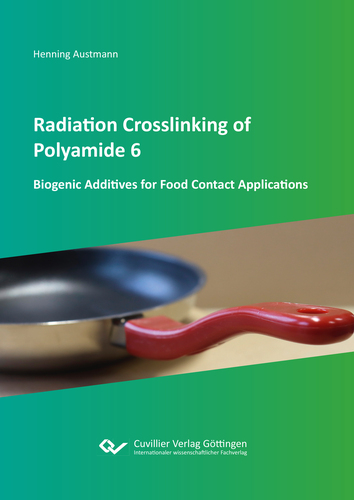
Radiation Crosslink of Polyamide 6
Biogenic Additives for Food Contact Applications
Hennig Austmann (Autor) ORCIDVorschau
Leseprobe, PDF (530 KB)
Inhaltsverzeichnis, PDF (120 KB)
Polyamide 6 is one of the most important engineering plastics and is widely used in demanding technical and food-contact applications. However, its thermal performance can be limited in applications requiring high heat-deflection resistance.
Radiation crosslinking can significantly improve the thermal and thermomechanical properties of PA6. However, conventional crosslinking enhancers such as triallyl isocyanurate are volatile, toxicologically problematic, and not approved for food-contact applications in Europe.
This work presents the development and evaluation of new biogenic and semi-biogenic crosslinking enhancers for the radiation crosslinking of PA6. Special emphasis is placed on allylamide-based additi ves, their synthesis, thermal stability, crosslinking efficiency, migration behaviour, and toxicological assessment in the context of European food-contact regulation. The results show that selected allylamides can effectively crosslink PA6 under electron-beam irradiation and improve heat-defl ection performance. Promising materials were further evaluated by genotoxicity and migration studies to assess their potential for future food-contact applications.
The study therefore connects polymer chemistry, material performance, toxicological evaluation, and European food-contact regulation.
| ISBN-13 (Printausgabe) | 9783689524708 |
| ISBN-13 (E-Book) | 9783689524715 |
| Buchendformat | B5 |
| Sprache | Englisch |
| Seitenanzahl | 352 |
| Umschlagkaschierung | matt |
| Auflage | 1. |
| Erscheinungsort | Göttingen |
| Erscheinungsdatum | 28.07.2026 |
| Allgemeine Einordnung | Dissertation |
| Fachbereiche |
Chemie
|
| Schlagwörter | Polyamide 6, PA6, Radiation crosslinking, Electron beam, Gamma irradiation, Crosslinking, Radical chemistry, Polymer networks, Gel content, Network density, Flory–Rehner, Charlesby–Pinner, G-value, Allylamides, Diallyldodecanediamide, Biobased additives, Reactive additives, Polyfunctional monomers, Thermomechanics, DMTA, Heat deflection temperature (HDT/B), Glass transition temperature, Thermal stability, Mechanical properties, Injection molding, Extrusion, 3D printing, Compounding, Food contact, Migration, Genotoxicity, Ames test, Micronucleus test, QSAR-based AI, Toxicology, Risk assessment, EFSA, EU 10/2011, Safe-by-design |


