
Cuvillier Verlag GmbH



| Areas | |
|---|---|
| Serie de libros (99) |
1415
|
| Nachhaltigkeit |
3
|
| Gesundheitswesen |
3
|
| Letra |
2415
|
| Ciencias Naturales |
5432
|
| Matemática | 230 |
| Informática | 320 |
| Física | 982 |
| Química | 1371 |
| Geociencias | 131 |
| Medicina humana | 247 |
| Estomatología | 10 |
| Veterinaria | 112 |
| Farmacia | 147 |
| Biología | 838 |
| Bioquímica, biología molecular, tecnología genética | 121 |
| Biofísica | 25 |
| Nutrición | 45 |
| Agricultura | 1006 |
| Silvicultura | 201 |
| Horticultura | 20 |
| Ecología y conservación de la tierra | 149 |
| Ciencias Ingeniería |
1822
|
| General |
97
|
|
Leitlinien Unfallchirurgie
5. Auflage bestellen |
|
Erweiterte Suche
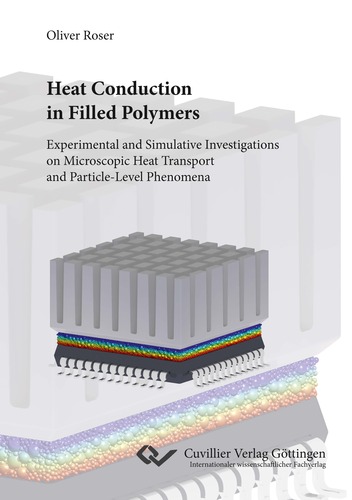
Heat Conduction in Filled Polymers Experimental and Simulative Investigations on Microscopic Heat Transport and Particle-Level Phenomena (Tienda española)
Oliver Roser (Autor)Previo
Lectura de prueba, PDF (2,5 MB)
Indice, PDF (1,7 MB)
Thermally conductive filled polymers are widely used in micro and power electronics as well as in electromobility. They have a highly complex and heterogeneous microstructure.
The present work describes the development and application of experimental and simulative methods to investigate the microscopic heat transport through filled polymers and
across filled polymer to substrate transitions. The aim is to develop a comprehensive understanding of the effects of various polymer, filler, and substrate properties on the effective thermal conductivity and on thermal contact resistance between filled polymers and solid surfaces.
Experimental studies are carried out using the steady-state cylinder method and a newly developed technique based on micro thermography. This enables microscopic resolution of the thermal contact resistances, providing insight into the mechanisms in filled polymer to substrate transitions that were previously unattainable.
In addition, microstructure simulation models assist the investigation into the processes inside the materials that cannot be resolved experimentally. The simulative investigations also allow an isolated analysis of individual influencing variables, which is only possible to a limited extent experimentally due to the versatile property profiles of available fillers. The geometrically detailed microstructure models can be constructed based on measurable material properties such as particle shape plus size distribution or surface structure of a substrate and thus reconstruct the structure of real sample materials.
Generally, the effect of the microscopic packing structure is more significant than that of the thermal properties of polymer, filler, and substrate. Particle morphology, size distribution, packing compaction and phenomena such as agglomeration and sedimentation define how well thermally conductive paths are formed in the material and which filler volume fractions are necessary to achieve the desired effective thermal conductivity. With multiscale filler blends, it is the combination of particle sizes, maximum packing densities and thermal conductivities in the individual fractions that largely affects the achievable effective
thermal conductivity.
Investigations on filled polymer to substrate transitions show that it is primarily the local disturbance of the particle packing structure by the adjacent substrate that leads to increased thermal contact resistance. Narrow particle size distributions and very smooth substrate surfaces favor the formation of a micro-order and intensify the effect, while very rough substrate surfaces and wide particle size distributions will increase the boundary layer thickness but reduce the thermal contact resistances.
In conclusion, a comprehensive overview of heat conduction in filled polymers is formulated,
deriving valuable knowledge for future material developments.
| ISBN-13 (Impresion) | 9783689523893 |
| ISBN-13 (E-Book) | 9783689523909 |
| Formato | A5 |
| Idioma | Inglés |
| Numero de paginas | 280 |
| Laminacion de la cubierta | Brillante |
| Edicion | 1. |
| Lugar de publicacion | Göttingen |
| Fecha de publicacion | 12.11.2025 |
| Clasificacion simple | Tesis doctoral |
| Area |
Física
Ciencias Ingeniería |
| Palabras claves | Thermalconductivity (TC), Thermal contact Resistance (TCR), Thermal Interfacial Resistance (TIR), Filled Polymers, Filled Polymer to Substrate Transitions (FPS), Thermal Interface Materials (TIM), Thermal Grease, Thermal Pad, Microstructure Simulations, Micro Thermography, Steady-State Cylinder Method, Ceramic and Metallic Fillers, Filler Blends, Heat Conduction, Filler Packing Structure, Multi-Scale, Multi Step Homogenization, Coarse-Graining, Effektive Wärmeleitfähigkeit, Thermischer Kontaktwiderstand, Thermischer Übergangswiderstand, Gefüllte Polymere, Thermische Interfacematerialien, Wärmeleitpaste, Wärmeleitpad, Mikrostruktur Simulationen, Mikrothermografie, Stationäre Zylindermethode, Keramische und metallische Füllstoffe, Füllstoffmischungen, Wärmeleitung, Packungsstruktur, Multi-Skalen, Mehr-Schritt Homogenisierung |
| URL para pagina web externa | https://www.linkedin.com/in/oliver-roser/ |


