
Cuvillier Verlag GmbH



| Departments | |
|---|---|
| Book Series (99) |
1415
|
| Nachhaltigkeit |
3
|
| Gesundheitswesen |
3
|
| Humanities |
2410
|
| Medienwissenschaften | 17 |
| Theology | 57 |
| Philosophy | 103 |
| Law | 430 |
| Economics | 863 |
| Social sciences | 423 |
| Sports science | 48 |
| Psychology | 233 |
| Educational science | 190 |
| History | 194 |
| Art | 111 |
| Cultural studies | 167 |
| Literary studies | 118 |
| Linguistics | 90 |
| Natural Sciences |
5428
|
| Engineering |
1820
|
| Common |
97
|
|
Leitlinien Unfallchirurgie
5. Auflage bestellen |
|
Advanced Search
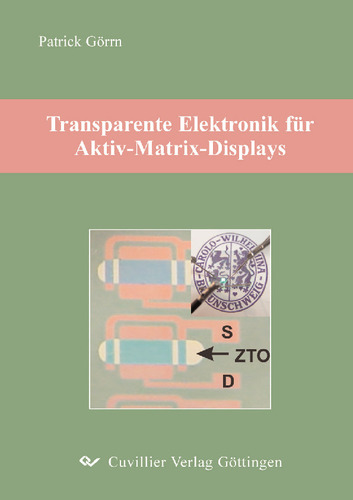
Transparente Elektronik für Aktiv-Matrix-Displays (English shop)
Patrick Görrn (Author)Preview
Table of Contents, Datei (41 KB)
Extract, Datei (71 KB)
“Transparent Electronics for Active-Matrix Displays”
The realization of large-area displays based on organic light-emitting diodes requires active-matrix addressing. Unlike in liquid crystal displays (LCDs), the electronics must not only act as a switch but, in addition, must supply the pixel current as a driver. This results in high demands on the thin-film transistors (TFTs).
TFTs based on transparent metal-oxide semiconductors achieve saturation field-effect mobilities of about μsat = 10 cm2/Vs, one order of magnitude above those of amorphous silicon. At the same time, they can achieve a transmission of more than 80% in the visible spectral range. This enables applications that would be inconceivable with amorphous silicon, such as fully transparent active-matrix OLED displays.
In this work, TFTs with an active channel consisting of a metal-oxide semiconductor are studied. The basis for the deposition of the active channel is oxygen plasma-assisted pulsed laser deposition (PAPLD). This technology provides radical oxygen species in order to improve the quality of the layer and to avoid an oxygen deficiency. Transparent, conductive layers of aluminium-doped zinc oxide (AZO) are deposited by PLD; atomic layer deposition (ALD) is used to fabricate dense dielectric layers with a low pinhole density.
Besides excellent transistor properties, such as field-effect mobilities in the range of μsat = 10 cm2/Vs and a threshold voltage close to 0 V, TFTs based on zinc tin oxide (ZTO) also exhibit particular stability. They are therefore considered ideally suited for application in transparent active-matrix displays. The fundamentals of the threshold shift of the oxide TFTs under bias stress are studied as a function of the composition of the channel material. At a [Zn]:[Sn] ratio of about 36:64, optimized stability is achieved. ZTO TFTs deposited at 450 °C additionally show an extremely low photosensitivity. Even very high illumination intensities at the shortest wavelengths required in a transparent display lead to a reduction of the TFT threshold by less than 1.7 V. The sensitivity of the ZTO channel to oxygen molecules is considerably lower than has been reported for other oxide semiconductors. In first experiments, the compatibility of the devices with a thin-film encapsulation comprising barrier layers against water and oxygen is demonstrated. This is of decisive importance for an application of the TFTs in OLED displays. The first transparent OLED pixels consisting of monolithically integrated transparent OLEDs and TFTs are presented. They exhibit an average transmission of 70% in the visible spectral range. In addition, active pixel drivers based on ZTO are realized that enable high-resolution OLED displays. They show excellent properties with respect to the achievable resolution (Full HD) and refresh rate (100 Hz), pixel crosstalk, as well as the achievable display brightness (2,200 cd/m2). These results demonstrate the feasibility of a transparent, high-resolution OLED display.
| ISBN-13 (Printausgabe) | 3867277583 |
| ISBN-13 (Hard Copy) | 9783867277587 |
| ISBN-13 (eBook) | 9783736927582 |
| Language | German |
| Page Number | 164 |
| Edition | 1 Aufl. |
| Volume | 0 |
| Publication Place | Göttingen |
| Place of Dissertation | TU Braunschweig |
| Publication Date | 2008-10-06 |
| General Categorization | Dissertation |
| Departments |
Social sciences
Electrical engineering |
| Keywords | transparent displaystransparent organic light-emitting diodes (OLEDs)transparent thin-film transistors (TFTs)transparent conductive oxides (TCOs)transparent amorphous oxide semiconductors (TAOS)stability of TFTsphotosensitivity of transparent TFTspulsed laser deposition (PLD)atomic layer deposition (ALD)thin-film encapsulation |


