
Cuvillier Verlag GmbH



| Departments | |
|---|---|
| Book Series (99) |
1415
|
| Nachhaltigkeit |
3
|
| Gesundheitswesen |
3
|
| Humanities |
2411
|
| Natural Sciences |
5429
|
| Engineering |
1821
|
| Engineering | 292 |
| Mechanical and process engineering | 872 |
| Electrical engineering | 700 |
| Mining and metallurgy | 30 |
| Architecture and civil engineering | 76 |
| Common |
97
|
|
Leitlinien Unfallchirurgie
5. Auflage bestellen |
|
Advanced Search
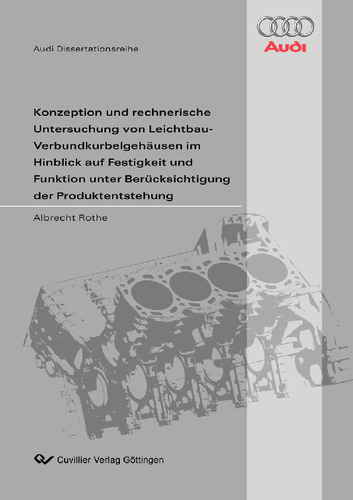
Konzeption und rechnerische Untersuchung von Leichtbau-Verbundkurbelgehäusen im Hinblick auf Festigkeit und Funktion unter Berücksichtigung der Produktentstehung (Volume 4) (English shop)
Albrecht Rothe (Author)Preview
Table of Contents, Datei (26 KB)
Extract, Datei (32 KB)
On the basis of the monolithic AUDI V8 aluminium cylinder crankcase (CC), three detailed designs in magnesium–aluminium–grey cast iron composite construction were developed, taking into account functional boundary conditions such as the realisation of a suitable cylinder liner surface, coolant routing, bolted joints, sealing surfaces, add-on parts, etc. The three variants represent the possible spectrum between maximum weight saving and the potential increase in weight-specific strength achieved through the composite design. As a result, a maximum weight saving of 21% (8.4 kg) compared with the aluminium baseline is achieved.
The evaluation of the deformations and stresses as well as their effects on the fatigue strength of the CC variants during subsequent engine operation was carried out by means of extensive simulations using the finite element method. In order to validate the manufacturing process, filling and solidification simulations were performed taking the cast-in inserts in die casting into account. By evaluating the strain and deformation state after cooling, conclusions were drawn regarding areas at risk of cracking as well as the bonding behaviour, with a view to avoiding detachment between the cast-in inserts and the surrounding cast material. The residual stresses resulting from the casting and manufacturing process were determined and their influence on fatigue strength as well as on function-relevant deformations and stresses was investigated. Furthermore, the results of metallographic investigations of the bonding between the surrounding cast material and the aluminium inserts, non-linear material models, the real temperature fields during engine operation and the creep behaviour of magnesium were taken into account in the finite element models. In order to verify the assumptions and results of the simulation, residual stress measurements, pulsating tests of the bearing block, bolted joint and ageing tests as well as casting trials with subsequent computed tomography investigations were carried out beforehand on the AUDI R4 magnesium hybrid cylinder crankcase.
| ISBN-13 (Printausgabe) | 3867276013 |
| ISBN-13 (Hard Copy) | 9783867276016 |
| ISBN-13 (eBook) | 9783736926011 |
| Final Book Format | A5 |
| Language | German |
| Page Number | 232 |
| Lamination of Cover | matt |
| Edition | 1 Aufl. |
| Book Series | Audi Dissertationsreihe |
| Volume | 4 |
| Publication Place | Göttingen |
| Place of Dissertation | TU Dresden |
| Publication Date | 2008-07-04 |
| General Categorization | Dissertation |
| Departments |
Mechanical and process engineering
|


