
Cuvillier Verlag GmbH



| Departments | |
|---|---|
| Book Series (99) |
1415
|
| Nachhaltigkeit |
3
|
| Gesundheitswesen |
3
|
| Humanities |
2410
|
| Natural Sciences |
5428
|
| Engineering |
1820
|
| Engineering | 292 |
| Mechanical and process engineering | 872 |
| Electrical engineering | 699 |
| Mining and metallurgy | 30 |
| Architecture and civil engineering | 76 |
| Common |
97
|
|
Leitlinien Unfallchirurgie
5. Auflage bestellen |
|
Advanced Search
Experimentelle Untersuchung der Lichtbogenaufteilung an Löschblechen (English shop)
Thomas Rüther (Author)Preview
Table of Contents, Datei (39 KB)
Preface, Datei (27 KB)
Extract, Datei (150 KB)
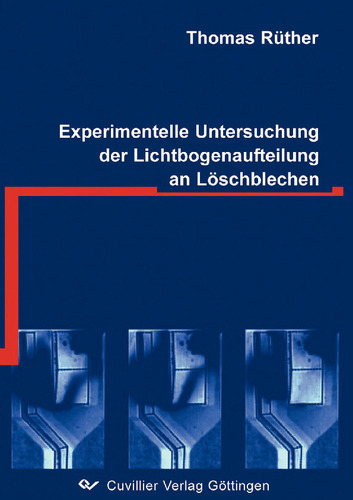
As development times become ever shorter, manufacturers of switching devices are shifting the development process from mechanical prototypes to computer-aided FEM simulation models. Consequently, the role of simulation tools in the development of low-voltage switching devices is becoming increasingly important. This growing importance is reinforced by the trend towards managing ever more power in ever less space. At present, the results obtained from the simulations still require verification by experimental investigations. Such a comparison provides conclusions regarding the validity of the simulations, reveals errors and allows missing parameters to be determined.
The most frequently used approach to arc extinction in low-voltage switching devices is the splitting of the switching arc — which forms after contact opening and migrates along the electrodes — at ferromagnetic splitter plates. Reproducing this behaviour in three-dimensional simulation models requires precise knowledge of the arc behaviour and the associated physical processes.
This work presents experimental investigations of arc splitting at a single splitter plate in model arcing chambers with parallel and with diverging arc runners. The chamber size is based on the size of miniature circuit breakers or small motor protection circuit breakers and corresponds to the strongly simplified, simulated chambers.
The influences of the chamber volume, of the openings in the enclosure and of the prospective current on arc splitting at the splitter plate were investigated. The partial current through the splitter plate, the positions of the arc roots on the splitter plate, the shape of the arc during the splitting process, the arc root current density on the splitter plate and the melting traces on the splitter plate surfaces were evaluated. In all tests, the arc was recorded optically with a digital high-speed camera.
The findings obtained from the measurements are subsequently compared with simulations for parallel arc runners carried out at the institute (Institut für Hochspannungstechnik und Elektrische Energieanlagen, TU Braunschweig). On the basis of the various simulation models, the influence of an arc root model on arc splitting is demonstrated.
| ISBN-13 (Printausgabe) | 3867275130 |
| ISBN-13 (Hard Copy) | 9783867275132 |
| ISBN-13 (eBook) | 9783736925137 |
| Final Book Format | A5 |
| Language | German |
| Page Number | 192 |
| Edition | 1 |
| Volume | 0 |
| Publication Place | Göttingen |
| Place of Dissertation | Braunschweig |
| Publication Date | 2008-02-07 |
| General Categorization | Dissertation |
| Departments |
Electrical engineering
|
| Keywords | Low-voltage switch, arc splitter plate, arc root, FEM simulation, arc simulation, high-speed film camera. |


