
Cuvillier Verlag GmbH



| Departments | |
|---|---|
| Book Series (99) |
1418
|
| Nachhaltigkeit |
3
|
| Gesundheitswesen |
3
|
| Humanities |
2418
|
| Medienwissenschaften | 17 |
| Theology | 57 |
| Philosophy | 103 |
| Law | 432 |
| Economics | 867 |
| Social sciences | 423 |
| Sports science | 48 |
| Psychology | 233 |
| Educational science | 190 |
| History | 194 |
| Art | 111 |
| Cultural studies | 168 |
| Literary studies | 119 |
| Linguistics | 91 |
| Natural Sciences |
5433
|
| Engineering |
1825
|
| Common |
97
|
|
Leitlinien Unfallchirurgie
5. Auflage bestellen |
|
Advanced Search
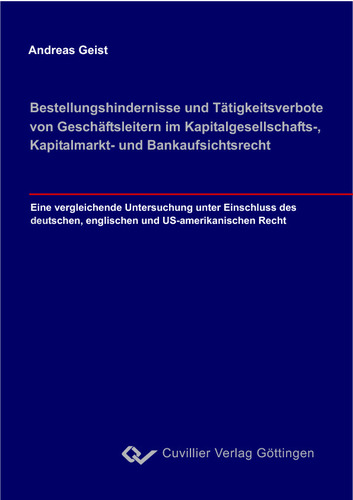
Bestellungshindernisse und Tätigkeitsverbote von Geschäftsleitern im Kapitalgesellschafts,- Kapitalmarkt- und Bankaufsichtsrecht (English shop)
Eine vergleichende Untersuchung unter Einschluss des deutschen, englischen und US-amerikanischen Rechts
Andreas Geist (Author)Preview
Table of Contents, Datei (90 KB)
Extract, Datei (81 KB)
After examining the legal systems of England and the USA with regard to whether and how individuals can be barred from serving on the management boards of corporations, German law appears in a new light. Whereas studying the German provisions in isolation is laborious, and systematic considerations all too often have to end in obscurity because of the limited perspective, looking beyond the confines of one’s own legal system can raise the observer to a new vantage point. From the elevated standpoint of comparative law, what was initially only a vague supposition becomes a certainty: taken as a whole, the provisions of German law cover only a portion of the possible fields of application for disqualification orders and, moreover, in some respects lack substantive completeness. Whereas the impediments to appointment under German corporation law have hitherto focused solely on creditors, the study has shown that, de lege ferenda, an extension in favour of the protection of shareholders and investors appears warranted. In this context, there is also much to be said for widening the horizon of consideration beyond the field of company law to the capital market. The professionalism of market participants, the high density of information and the institutional penetration of the capital market provide many indications that disqualification orders in this area can serve investor protection – and thus indirectly the proper functioning of the capital market – with particular effectiveness. In comparative terms, US capital markets law serves above all as the model here. Partly overlapping with investor protection, the protection of shareholders also calls for attention. As the study has shown, there are good reasons to consider disqualification orders for the protection of shareholders where their interests cannot be adequately safeguarded. This does not apply without exception to the capital market, but it is there above all that it is all too often palpable.
| ISBN-13 (Printausgabe) | 3867270244 |
| ISBN-13 (Hard Copy) | 9783867270243 |
| ISBN-13 (eBook) | 9783736920248 |
| Language | German |
| Page Number | 404 |
| Edition | 1 |
| Volume | 0 |
| Publication Place | Göttingen |
| Place of Dissertation | Göttingen |
| Publication Date | 2006-10-13 |
| General Categorization | Dissertation |
| Departments |
Law
|


