
Cuvillier Verlag GmbH



| Departments | |
|---|---|
| Book Series (99) |
1415
|
| Nachhaltigkeit |
3
|
| Gesundheitswesen |
3
|
| Humanities |
2412
|
| Natural Sciences |
5430
|
| Engineering |
1821
|
| Engineering | 292 |
| Mechanical and process engineering | 872 |
| Electrical engineering | 700 |
| Mining and metallurgy | 30 |
| Architecture and civil engineering | 76 |
| Common |
97
|
|
Leitlinien Unfallchirurgie
5. Auflage bestellen |
|
Advanced Search
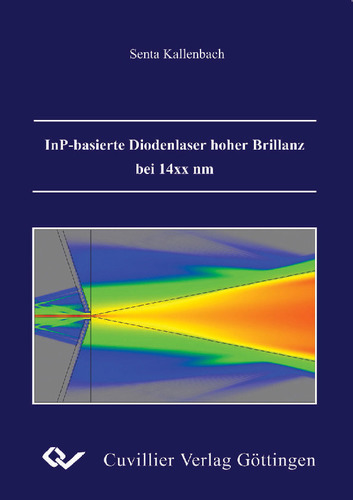
InP-basierte Diodenlaser hoher Brillanz bei 14xx nm (English shop)
Senta Kallenbach (Author)Preview
Table of Contents, Datei (52 KB)
Extract, Datei (170 KB)
Within the scope of this work, InGaAsP tapered lasers epitaxially grown by solid-source MBE emitting at 14xx nm could be demonstrated for the first time. The first part of the work dealt with the design of the vertical structure. For the modelling, a passive calculation of the mode profile in the fast-axis direction was used. Two approaches to dimensioning the epitaxial layers were pursued: on the one hand, the LOC concept, well established for GaAs high-power lasers, was transferred to InGaAsP in order to realise structures with low optical losses. The other approach comprised a structure with thin waveguide layers, which enables a higher modal gain and provided more design freedom for further development. Various LOC structures and one vertical structure with a narrow waveguide were realised experimentally and characterised in pulsed operation using rapid-process emitters. It was shown that a spacer layer on both sides of the active zone increased the internal quantum efficiency of the device by about 15% and thus contributes to a lower laser threshold. A variation of the number of quantum wells in the LOC-based structures allowed the extraction of the material gain and the transparency current density, which entered the BPM simulation of the tapered lasers as parameters. Furthermore, a prediction for an optimised active zone specifically for the tapered laser could be derived from this: with four QWs (LOC structure) or three QWs (narrow waveguide), a minimisation of the threshold current was to be expected. Of all the vertical structures investigated, the structure variant with a narrow waveguide exhibited the best electro-optical properties, which could be attributed to a better carrier capture in the active zone and to the higher modal gain. A variation of the doping profile showed that the lower limit of the internal losses lies at about 7 cm−1, since at a lower p-doping the internal quantum efficiency deteriorates dramatically. Here again, the advantage of the LOC concept was confirmed, with which internal losses between 2.0 and 3.3 cm−1 could be realised. These values are in the range of the best values published for InGaAsP lasers at this wavelength.
| ISBN-13 (Printausgabe) | 3865378838 |
| ISBN-13 (Hard Copy) | 9783865378835 |
| ISBN-13 (eBook) | 9783736918832 |
| Final Book Format | A5 |
| Language | German |
| Page Number | 156 |
| Edition | 1 |
| Volume | 0 |
| Publication Place | Göttingen |
| Place of Dissertation | Karlsruhe |
| Publication Date | 2006-05-31 |
| General Categorization | Dissertation |
| Departments |
Electrical engineering
|


