
Cuvillier Verlag GmbH



| Departments | |
|---|---|
| Book Series (99) |
1415
|
| Nachhaltigkeit |
3
|
| Gesundheitswesen |
3
|
| Humanities |
2411
|
| Natural Sciences |
5429
|
| Engineering |
1821
|
| Engineering | 292 |
| Mechanical and process engineering | 872 |
| Electrical engineering | 700 |
| Mining and metallurgy | 30 |
| Architecture and civil engineering | 76 |
| Common |
97
|
|
Leitlinien Unfallchirurgie
5. Auflage bestellen |
|
Advanced Search
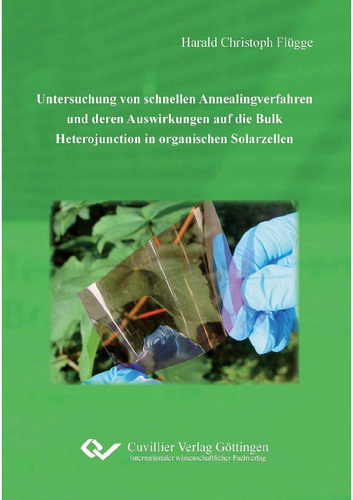
Untersuchung von schnellen Annealingverfahren und deren Auswirkungen auf die Bulk Heterojunction in organischen Sollarzellen (English shop)
Harald Christoph Flügge (Author)Preview
Table of Contents, Datei (47 KB)
Extract, Datei (77 KB)
Since the invention of the first organic solar cells in 1986 by Tang et al.1, intensive research has been conducted in the field of organic photovoltaics (OPV). OPV differs from inorganic solar cells in its very thin and semitransparent layers and in the possibility of straightforward fabrication by printing processes suitable for mass production.
The performance of the solar cell is influenced by external factors such as contact and transport layers, the layer thicknesses and the material system used. If these are kept constant, the efficiency depends on the morphological aspects of an interpenetrating network (bulk heterojunction) formed by the donor and acceptor molecules of the material system used. In P3HT:PCBM solar cells (poly(3-hexylthiophene):phenyl-C61-butyric acid methyl ester), the performance can be significantly increased by post-treatment processes (so-called annealing).
In this work, four conditions for the morphology of efficient solar cells were defined, namely the domain sizes, the charge carrier mobility, the formation of transport pathways and vertical concentration gradients. On the basis of these four conditions, various annealing methods and their effects on the morphology of P3HT:PCBM solar cells were investigated. The focus of this work lies, first, on the investigation of the morphology of the solar cells and, second, on the study of rapid annealing methods. Electrical device measurements are compared with morphological investigations. Through the use of analytical transmission electron microscopy (TEM), P3HT-rich and PCBM-rich domains can be depicted separately from one another at nanometre resolution.
Initially, the effects of thermal annealing on P3HT:PCBM solar cells are investigated. A rapid increase in efficiency could be demonstrated. This is attributed to improved charge transport through network formation and partial crystallisation of P3HT. On the basis of the investigation of the vertical concentration profile, no preferred current direction could be found in the morphology.
To investigate rapid annealing processes, solar cells were irradiated with electromagnetic radiation in the microwave spectral range at 2.45 GHz. An absorption of the radiation depending on the sheet resistance could be demonstrated. By heating the ITO (indium tin oxide) anode, the P3HT:PCBM layers could be fabricated efficiently within only a few seconds by means of steep temperature ramps. Morphological investigations confirmed a very rapid structure formation in the P3HT:PCBM layer.
Finally, by using nitrobenzene as a solvent additive, solar cells could also be built efficiently without an annealing step. Depending on the nitrobenzene concentration, crystal formation of P3HT takes place during solvent evaporation in the coating process. The formation of a P3HT:PCBM network during coating could be demonstrated. This network gives rise to a vertical concentration gradient and enables the fabrication of highly temperature-stable solar cells.
1C. W. Tang. Two-layer organic photovoltaic cell. Appl. Phys. Lett., 48(2):183-185, 1986.
| ISBN-13 (Printausgabe) | 3954041030 |
| ISBN-13 (Hard Copy) | 9783954041039 |
| ISBN-13 (eBook) | 9783736941038 |
| Final Book Format | A5 |
| Language | German |
| Page Number | 186 |
| Lamination of Cover | glossy |
| Edition | 1 Aufl. |
| Volume | 0 |
| Publication Place | Göttingen |
| Place of Dissertation | Braunschweig |
| Publication Date | 2012-05-09 |
| General Categorization | Dissertation |
| Departments |
Electrical engineering
|


