
Cuvillier Verlag GmbH



| Departments | |
|---|---|
| Book Series (99) |
1415
|
| Nachhaltigkeit |
3
|
| Gesundheitswesen |
3
|
| Humanities |
2412
|
| Natural Sciences |
5430
|
| Engineering |
1821
|
| Engineering | 292 |
| Mechanical and process engineering | 872 |
| Electrical engineering | 700 |
| Mining and metallurgy | 30 |
| Architecture and civil engineering | 76 |
| Common |
97
|
|
Leitlinien Unfallchirurgie
5. Auflage bestellen |
|
Advanced Search
Phasenübergänge, Frostschwinden und Schrumpfvorgänge im Zementstein (English shop)
- Phasenübergänge und Transportmechanismen -
Alexander Liebrecht (Author)Preview
Table of Contents, Datei (38 KB)
Preface, Datei (26 KB)
Extract, Datei (230 KB)
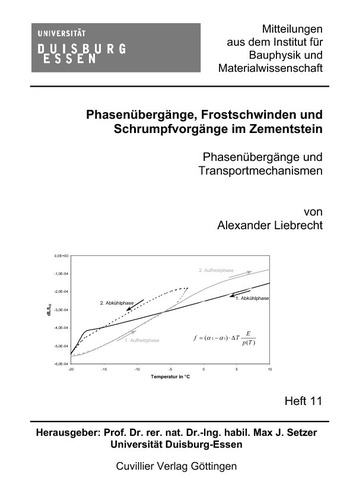
This study addresses the scientific fundamentals of the durability of concrete. It builds on earlier dissertations by Zech and Stockhausen and combines them with more recent findings from laboratory testing and construction practice. For the durability and the mechanical properties of concrete, the interaction with the environment—in particular with water and water vapour as well as with substances dissolved in water—is a decisive aspect. The transport processes within concrete are likewise coupled to this. All of these phenomena, which govern the behaviour of the material, are influenced by the fact that concrete not only obeys the laws of macroscopic physics and chemistry, but is also modified to an equal degree by surface physics and chemistry on account of its large internal surface area. It is therefore very important to gain a better understanding of these interrelations between nanophysics and macroscopic physics. The present work has investigated important partial aspects of submicroscopic physics and their influence on the macroscopic behaviour of the material concrete, or rather hardened cement paste. The phase transitions of water below 0° C are a striking example of the effects of surface physics. They bring it about that, down to -60° C, unfrozen water coexists with ice in hardened cement paste. This in turn has a considerable influence on mechanical properties such as frost shrinkage and frost suction. In addition to these thermally induced shrinkage and swelling processes, the shrinkage processes during the hydration of the cement paste are also decisive. For they alter the microstructure of the hardened cement paste, and do so decisively with regard to durability, which would certainly not be given without the shrinkage pores that thereby arise.
| ISBN-13 (Printausgabe) | 3865378404 |
| ISBN-13 (Hard Copy) | 9783865378408 |
| ISBN-13 (eBook) | 9783736918405 |
| Final Book Format | A5 |
| Language | German |
| Page Number | 176 |
| Lamination of Cover | glossy |
| Edition | 1 |
| Volume | 0 |
| Publication Place | Göttingen |
| Place of Dissertation | Duisburg-Essen |
| Publication Date | 2006-04-10 |
| General Categorization | Dissertation |
| Departments |
Architecture and civil engineering
|


