
Cuvillier Verlag GmbH



| Departments | |
|---|---|
| Book Series (99) |
1415
|
| Nachhaltigkeit |
3
|
| Gesundheitswesen |
3
|
| Humanities |
2411
|
| Natural Sciences |
5430
|
| Engineering |
1821
|
| Engineering | 292 |
| Mechanical and process engineering | 872 |
| Electrical engineering | 700 |
| Mining and metallurgy | 30 |
| Architecture and civil engineering | 76 |
| Common |
97
|
|
Leitlinien Unfallchirurgie
5. Auflage bestellen |
|
Advanced Search
Entwicklung eines neuen Feldeffekt-Gassensors mit hybriden Gate-Aufbau und vertikalen Transistordesign (English shop)
Gunter Freitag (Author)Preview
Table of Contents, Datei (55 KB)
Extract, Datei (130 KB)
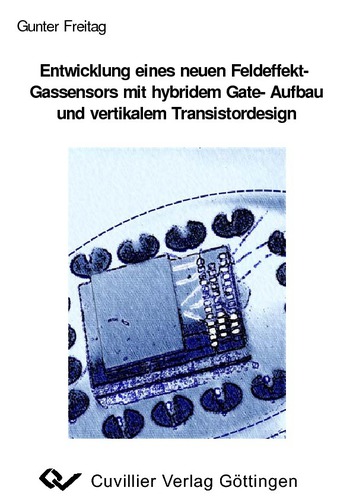
This work presents a new concept for a field-effect gas sensor with a floating gate and a vertical read-out transistor for measuring gas concentrations, and addresses its realisation and the development of a fabrication process for such a sensor. For the first time, a gas sensor based on the principle of field-effect transistors with an air gap is fabricated entirely at the Institut für Nanotechnologie und Mikrosystemtechnik of the Universität der Bundeswehr. Measurements on a first prototype are presented.
The work begins with an overview of the approaches to measuring gas concentrations by means of a microsystem. Sensors that employ transistors directly as transducers prove to be extremely favourable with respect to low energy consumption, fast response times, the potential for further scalability, the capability of integration and, finally, the prospect of low fabrication costs. Compared with other GASFETs, the principle of measuring gas concentrations by means of a transistor with an air gap has the advantage of measuring only surface effects. This guarantees fast response times, since the gas does not first have to diffuse into the bulk of a material. The concept of the developed FGFET (Floating Gate FET) is based on the HSGFET (Hybrid Suspended Gate Field Effect Transistor), a field-effect transistor with an air gap. This design allows the use of a large number of sensitive materials. In comparison, the FGFET proves to be the more promising candidate over the HSGFET, because it offers greater sensitivity at a lower operating voltage. The reason for this is the large gate capacitance, thanks to a thin gate oxide of the read-out transistor.
| ISBN-13 (Printausgabe) | 3865374484 |
| ISBN-13 (Hard Copy) | 9783865374486 |
| ISBN-13 (eBook) | 9783736914483 |
| Language | German |
| Page Number | 180 |
| Edition | 1 Aufl. |
| Volume | 0 |
| Publication Place | Göttingen |
| Place of Dissertation | München |
| Publication Date | 2005-05-19 |
| General Categorization | Dissertation |
| Departments |
Electrical engineering
|


