
Cuvillier Verlag GmbH



| Departments | |
|---|---|
| Book Series (99) |
1415
|
| Nachhaltigkeit |
3
|
| Gesundheitswesen |
3
|
| Humanities |
2412
|
| Natural Sciences |
5430
|
| Engineering |
1821
|
| Engineering | 292 |
| Mechanical and process engineering | 872 |
| Electrical engineering | 700 |
| Mining and metallurgy | 30 |
| Architecture and civil engineering | 76 |
| Common |
97
|
|
Leitlinien Unfallchirurgie
5. Auflage bestellen |
|
Advanced Search
Einfluss des Materials und der Kontaktierung der Barrieren auf die Homogenität von Barrierenentladungen (English shop)
Peng Li (Author)Preview
Table of Contents, Datei (76 KB)
Preface, Datei (72 KB)
Extract, Datei (330 KB)
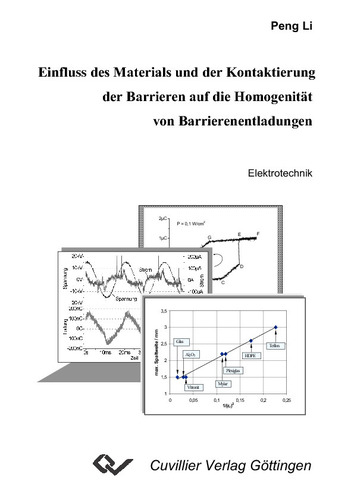
Previous literature indicates that homogeneous barrier discharges generally exist only within rather narrow ranges of the supply voltage or the gap widths. In an earlier work, two fundamentally different homogeneous discharge forms (type 1 according to Okazaki and type 2 according to Massines) were demonstrated. The aim of this work was to gain concrete insights, through systematic experiments and complementary simulations, into achievable and technically usable existence ranges as well as into the influence of the type of electrical contacting and of the barrier material on the homogeneity of barrier discharges. At 50 Hz, all investigated arrangements with wire mesh or resistive layers between the barrier rear sides and the electrodes initially exhibit, at discharge inception, a low-current homogeneous discharge of type 2. With some contacting variants, the initially pure type-2 discharge changes into a combined type-2/type-1 discharge, which exists very stably up to the highest supply voltage. The 50 Hz behaviour of barrier arrangements with contacting layers is almost identical for air and nitrogen as working gas. For the homogeneous type-2 discharge in the kHz range, its voltage existence range narrows with increasing gap width. This gap width existence range was investigated with numerous barrier materials. Either solid plates or two-layer combinations with different permittivities on the side facing the discharge space (surface permittivity) were used. As an important new result, it was found that the existence range does not depend on the resulting barrier capacitance, but exclusively on the surface permittivity of the barriers. The homogeneous discharges were subjected to a power analysis. Furthermore, current distribution measurements, high-speed imaging and emission spectroscopy were carried out. Simulations serve as a complement and for interpretation.
| ISBN-13 (Printausgabe) | 3865372139 |
| ISBN-13 (Hard Copy) | 9783865372130 |
| ISBN-13 (eBook) | 9783736912137 |
| Language | German |
| Page Number | 140 |
| Edition | 1 Aufl. |
| Volume | 0 |
| Publication Place | Göttingen |
| Place of Dissertation | Braunschweig |
| Publication Date | 2004-09-20 |
| General Categorization | Dissertation |
| Departments |
Electrical engineering
|


