
Cuvillier Verlag GmbH



| Departments | |
|---|---|
| Book Series (99) |
1415
|
| Nachhaltigkeit |
3
|
| Gesundheitswesen |
3
|
| Humanities |
2413
|
| Medienwissenschaften | 17 |
| Theology | 57 |
| Philosophy | 103 |
| Law | 430 |
| Economics | 864 |
| Social sciences | 423 |
| Sports science | 48 |
| Psychology | 233 |
| Educational science | 190 |
| History | 194 |
| Art | 111 |
| Cultural studies | 168 |
| Literary studies | 119 |
| Linguistics | 91 |
| Natural Sciences |
5430
|
| Engineering |
1822
|
| Common |
97
|
|
Leitlinien Unfallchirurgie
5. Auflage bestellen |
|
Advanced Search
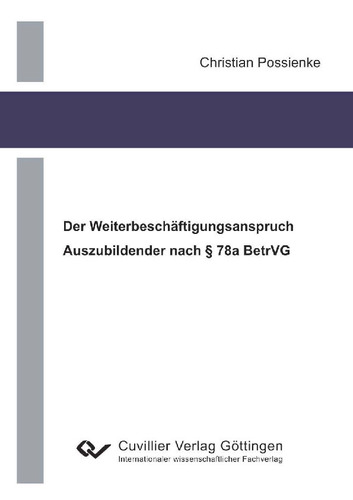
Der Weiterbeschäftigungsanspruch Auszubildender nach § 78a BetrVG (English shop)
Christian Possienke (Author)Preview
Table of Contents, Datei (84 KB)
Extract, Datei (32 KB)
Section 78a BetrVG enables trainees who are members of the youth and trainee representation body, the works council or another body established under works constitution law within the meaning of the provision to obtain a permanent employment relationship upon expiry of the training relationship – without, and where applicable even against, the employer’s will. For this reason, Section 78a BetrVG constitutes an important and, moreover, extremely challenging provision for employers, on the basis of which an employment relationship with an employee that is not actually desired can be imposed upon them. For mandated trainees, by contrast, the provision affords protection at the end of their training period against unjustified disadvantage compared with non-mandated trainees on account of the works constitution activity they have performed.
In many establishments and companies, the question therefore arises, on the employer’s side, of how an obligation to take on a trainee must be dealt with where employment opportunities are lacking overall, and whether in this respect there are motives on the part of the employer worthy of protection that argue against taking the trainee on. On the trainees’ side, on the other hand, the question arises whether and under what conditions certain trainees are protected by Section 78a BetrVG and how this protection is to be obtained. For employers and mandated trainees there is therefore currently a large degree of legal uncertainty with regard to continued employment after completion of training, owing to Section 78a BetrVG and the uncertainty as to its applicability.
The study examines the personal and substantive requirements of the claim to continued employment under Section 78a BetrVG, in particular which requirements must be placed on a necessary vacant position. It presents the ways in which attempts are made in practice to prevent the legal consequences of Section 78a BetrVG from taking effect, by changing companies’ training or employment activities or by making use of the possibility of establishing different employment obligations of the employer, or none at all, through contractual arrangements.
Finally, it contains various proposals as to how Section 78a BetrVG could be adapted to operational reality and necessity.
| ISBN-13 (Printausgabe) | 3869556579 |
| ISBN-13 (Hard Copy) | 9783869556574 |
| ISBN-13 (eBook) | 9783736936577 |
| Final Book Format | A5 |
| Language | German |
| Page Number | 336 |
| Lamination of Cover | matt |
| Edition | 1 Aufl. |
| Volume | 0 |
| Publication Place | Göttingen |
| Place of Dissertation | Universität Hannover |
| Publication Date | 2011-03-01 |
| General Categorization | Dissertation |
| Departments |
Law
|
| Keywords | Right of trainees to continued employment, works constitution law, right to continued employment under works constitution law, right to continued employment pursuant to § 78a BetrVG, obligation to take on trainees |


