
Cuvillier Verlag GmbH



| Departments | |
|---|---|
| Book Series (99) |
1415
|
| Nachhaltigkeit |
3
|
| Gesundheitswesen |
3
|
| Humanities |
2412
|
| Natural Sciences |
5430
|
| Engineering |
1821
|
| Engineering | 292 |
| Mechanical and process engineering | 872 |
| Electrical engineering | 700 |
| Mining and metallurgy | 30 |
| Architecture and civil engineering | 76 |
| Common |
97
|
|
Leitlinien Unfallchirurgie
5. Auflage bestellen |
|
Advanced Search
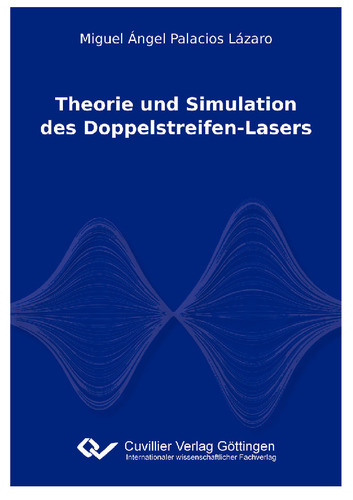
Theorie und Simulation des Doppelstreifen-Lasers (English shop)
Miguel Ángel Palacios Lázaro (Author)Preview
Table of Contents, Datei (36 KB)
Extract, Datei (110 KB)
In today’s world, the exchange of information is one of the strongest engines of the economy and of the development of society. Accordingly, communications engineering plays an ever more important and significant role in research, technology and education. New systems are being developed, existing ones are constantly being improved, and their data transmission rates are crossing further boundaries. These processes are the response to the growing demand for technical solutions that support the growth of the economic and technological world mentioned above.
Among these solutions, optical transmission systems are those that enable the highest data transmission rates. Over very long distances, optical fibres can transmit analogue as well as digital information. The use of optical amplifiers (EDFA) has raised the scale of this information exchange to a hitherto unknown magnitude.
Laser diodes are used as the sources of these systems, and they can be designed and fabricated using a wide variety of technologies. These diodes (Fabry–Pérot and DFB laser diodes, homojunction, heterojunction and quantum well laser diodes) are mostly driven by modulated currents, so that the information is transmitted in the baseband. The use of these sources for generating microwave and millimetre-wave oscillations is, however, a less well-known field of application.
Twin-stripe lasers are semiconductor structures in which not just one active layer but two parallel active stripes are buried. The existence of these two active regions enables the emergence of an oscillation of the light emitted by the semiconductor. Under certain conditions, this light could be modulated or used as a microwave or millimetre-wave oscillator.
This work deals with this type of structure. The introduction presents the principles of the generation of coherent light, as well as the most widespread types of laser diodes.
Subsequently, the theoretical foundations of the work are presented. The aim of our research is the development of a model that contributes to a theoretical understanding of the twin-stripe laser. This understanding is intended to lead to the optimisation of this structure. The generation of a low-noise oscillation in the gigahertz range is the ultimate purpose of the optimisation.
This work starts from the application of a travelling-wave model. Conventional models, however, have been applied to the simulation of ordinary lasers with a single active stripe. Based on the theory of these models, a travelling-wave model for twin-stripe lasers was developed. The emergence of two simultaneously existing lateral modes (referred to as the symmetric and antisymmetric mode, respectively), which exhibit slightly different refractive indices, enables the generation of the desired oscillation.
According to our considerations, two applications of this phenomenon are of importance in communications engineering:
• A laser can only be modulated in the baseband. Once a device-dependent frequency (fc) is reached, the optical power drops sharply. For this reason, the bandwidth of the modulating signals can only amount to a few gigahertz. The generation of an oscillation in the gigahertz range, however, makes it possible to modulate the laser around this oscillation, which offers an additional bandwidth for signal transmission, as this work has demonstrated.
• A particularly important application of a twin-stripe laser can be achieved through the optimisation of the generated oscillation. This leads to a low-noise oscillation with a very narrow linewidth. Such oscillations can be employed as microwave and millimetre-wave sources that are transmitted and distributed over long distances by means of optical fibre, which is very attractive from a communications engineering point of view. Until now, such narrow linewidths could only be achieved by means of complicated systems (e.g. via optical injection). The present work has shown that the optical coupling inherent in the twin-stripe laser enables a technically feasible reduction of the linewidth.
The extension of the travelling-wave model and the theoretical explanation of the second of the applications mentioned above constitute the most important results of the present work, which could serve as a basis for a future, practical development of such sources.
| ISBN-13 (Printausgabe) | 3869555971 |
| ISBN-13 (Hard Copy) | 9783869555973 |
| ISBN-13 (eBook) | 9783736935976 |
| Final Book Format | A5 |
| Language | German |
| Page Number | 212 |
| Lamination of Cover | matt |
| Edition | 1 Aufl. |
| Volume | 0 |
| Publication Place | Göttingen |
| Place of Dissertation | TU Hamburg-Harburg |
| Publication Date | 2011-01-13 |
| General Categorization | Dissertation |
| Departments |
Electrical engineering
|
| Keywords | Laser, TSL, oscillator, microwaves, low-noise, bandwidth, twin stripe laser, Twin Stripe Laser, microwave oscillator, low noise, linewidth, travelling-wave model, symmetric mode, antisymmetric mode, tunable oscillator |


