
Cuvillier Verlag GmbH



| Departments | |
|---|---|
| Book Series (99) |
1415
|
| Nachhaltigkeit |
3
|
| Gesundheitswesen |
3
|
| Humanities |
2411
|
| Natural Sciences |
5429
|
| Engineering |
1821
|
| Engineering | 292 |
| Mechanical and process engineering | 872 |
| Electrical engineering | 700 |
| Mining and metallurgy | 30 |
| Architecture and civil engineering | 76 |
| Common |
97
|
|
Leitlinien Unfallchirurgie
5. Auflage bestellen |
|
Advanced Search
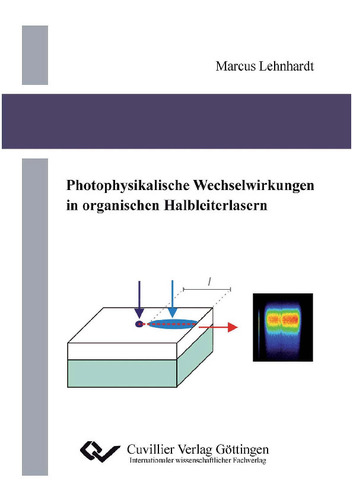
Photophysikalische Wechselwirkungen in organischen Halbleiterlasern (English shop)
Marcus Lehnhardt (Author)Preview
Table of Contents, Datei (61 KB)
Extract, Datei (150 KB)
In organic semiconductor lasers, a multitude of different photophysical processes and interactions occur which massively influence the properties of the laser. Using and developing in part novel investigation methods, the present work provides far-reaching insight into the properties of triplet excitons, polaron absorption and optical gain, and thus determines their effects on the laser emission.
Particular attention is paid to the triplet excitons, since they exert a decisive influence both under optical excitation and, even more so, under the desired electrical excitation of organic lasers. A novel waveguide-based measurement technique is presented with which triplet absorption in fluorescent materials can be investigated at room temperature and in an amorphous thin film. The results of the measurements provide values for the spectral characteristics of the triplet absorption, the triplet lifetime, the triplet-triplet annihilation rate as well as the triplet-singlet annihilation rate. In the investigation of the triplet lifetime in the fluorescent guest-host systems, a stabilisation of the triplet excitons on the guest molecule is demonstrated for the first time.
Based on the insights thus gained about the triplet excitons, the temporal dynamics of organic lasers are investigated. Under excitation with a GaN laser diode, poly[(9,9-di-n-octylfluorenyl-2,7-diyl)-alt-(benzo[2,1,3]thiadiazol-4,8-diyl)]/poly[2-methoxy-5-(2-ethylhexyloxy)]-1,4-phenylene vinylene (F8BT/MEH-PPV) lasers exhibit a cessation of laser emission only a few nanoseconds after the onset of excitation. Using an adapted mathematical model, this behaviour is explained and the influence of the triplet absorption as well as of the triplet-singlet annihilation is determined. With the investigation methods developed within the framework of this work for the characterisation of the triplet excitons and for the determination of the optical gain, comprehensive data are available for the first time to describe the dynamics of the laser emission. In investigations of the triplet excitons in 6,6’-(2,2’-octyloxy-1,1’-binaphthyl)/poly(9,9-dioctylfluorene) (BN-PFO) based lasers, a spectral separation of the triplet absorption and the optical gain is demonstrated. Based on these results, earlier investigations of the dynamics of BN-PFO-based lasers are explained for the first time. The separation of optical gain and triplet absorption leads to a constant laser emission independent of the repetition rate and the pulse length of the excitation and enables continuous-wave operation of the organic laser.
The second part of the present work deals with the realisation of an organic laser diode and the photophysical interactions arising therein. First, a device structure is presented which enables a very low laser threshold current density. Based on this optimised structure, the influence of charge carrier absorption is investigated. The polaron absorption in organic semiconductor materials is determined with a novel waveguide-based measurement technique. It is shown that in the material 2-(9,9’-spirobifluoren-2-yl)-9,9’-spirobifluorene (BSBF) the high polaron absorption suppresses electrically excited laser emission. The material 1,3-bis[2-(2,2’-bipyridine-6-yl)-1,3,4-oxadiazo-5-yl]benzene (Bpy-OXD) and in particular the hole transporter 2,2’,7,7’-tetrakis(N,N-diphenylamino)-9,9’-spirobifluorene (S-TAD), by contrast, exhibit a spectral window of low polaron absorption, which leads only to a moderate increase of the laser threshold.
In addition to the results important for the realisation of an organic laser diode, organic lasers on flexible self-organised PDMS substrates are investigated for the first time. Furthermore, the determination of the charge carrier density in electrochemically doped materials by means of the polaron absorption cross section is presented.
| ISBN-13 (Printausgabe) | 3954040581 |
| ISBN-13 (Hard Copy) | 9783954040582 |
| ISBN-13 (eBook) | 9783736940581 |
| Final Book Format | A5 |
| Language | German |
| Page Number | 156 |
| Lamination of Cover | glossy |
| Edition | 1 Aufl. |
| Volume | 0 |
| Publication Place | Göttingen |
| Place of Dissertation | Braunschweig |
| Publication Date | 2012-03-26 |
| General Categorization | Dissertation |
| Departments |
Electrical engineering
|


