
Cuvillier Verlag GmbH



| Departments | |
|---|---|
| Book Series (99) |
1418
|
| Nachhaltigkeit |
3
|
| Gesundheitswesen |
3
|
| Humanities |
2418
|
| Medienwissenschaften | 17 |
| Theology | 57 |
| Philosophy | 103 |
| Law | 432 |
| Economics | 867 |
| Social sciences | 423 |
| Sports science | 48 |
| Psychology | 233 |
| Educational science | 190 |
| History | 194 |
| Art | 111 |
| Cultural studies | 168 |
| Literary studies | 119 |
| Linguistics | 91 |
| Natural Sciences |
5433
|
| Engineering |
1825
|
| Common |
97
|
|
Leitlinien Unfallchirurgie
5. Auflage bestellen |
|
Advanced Search
Information über Information (English shop)
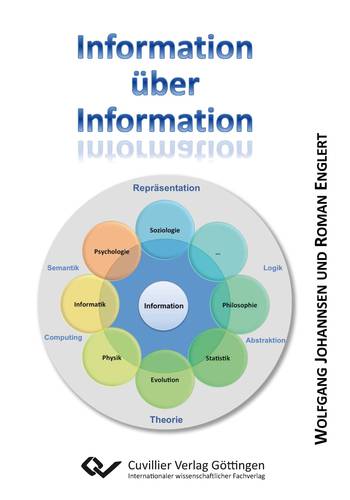
ZUM WESEN DER INFORMATION IM SPEKTRUM VON Informatik, Thermodynamik, Quantenphysik, Evolution, Statistik, Logik & Philosophie
Roman Englert (Author)Wolfgang Johannsen (Author)
Preview
Extract, PDF (120 KB)
Table of Contents, PDF (40 KB)
In this contribution we explore the nature and essence of information from a contemporary scientific and epistemological perspective. We pursue the thesis that information is not only fundamental to our understanding of the structure of the world, but also has fundamental significance for the physical structure of the world. This is done on the basis of the question of the real, i.e. the role of information as a reality-creating phenomenon for the perceiving human being, and the present-day scientific understanding thereof.
Four strands of scientific knowledge formation are pursued here: first, we concentrate on information theory and on thermodynamics. Important aspects of quantum physics and quantum computing, and finally aspects of evolution and genetics, form the two further strands. In doing so, we also take into account approaches that assign significance to information as a physical phenomenon.
The scientific perspectives are supplemented by a discourse on relevant aspects of statistics and logic. Statistics represents information while incorporating the aspect of chance and, in quantum physics, provides the path to describing the real. A supplementation of classical logic by so-called intuitionistic logic is based on the traceability of statements, or of the information represented. Information thus acquires a perceptible reality through the construction from its representation.
As an essential result, it is shown that information can be understood as a new “quintessence” (in reference to the quintessentia of antiquity), which not only fits into the picture of the natural sciences and of philosophy, but whose essence also helps to grasp an understanding of the connection between nature as it can be experienced and nature as it cannot be understood – because it is withdrawn from our classical understanding of nature.
| ISBN-13 (Hard Copy) | 9783954041596 |
| ISBN-13 (eBook) | 9783736941595 |
| Final Book Format | A5 |
| Language | German |
| Page Number | 92 |
| Lamination of Cover | matt |
| Edition | 1. Aufl. |
| Publication Place | Göttingen |
| Publication Date | 2012-07-20 |
| General Categorization | Non-Fiction |
| Departments |
Philosophy
Systematic philosophy Informatics Physics Elementary particle physics and nuclear physics |
| Keywords | Computability, Turing machine, Kolmogorov complexity, emergence, DNA / RNA, decoherence, evolution, gene, selection, selfish gene, self-organization, information, abstractability, provability, extensibility, concept of information, information theory, interpretability, quantum information, representation of information, semantics, logic, closure properties, dichotomous logics, Euclidean axioms, intuitionism, intuitionistic logic, connective philosophy, determinism, reductionism, thing-in-itself, constructivism, ontology, epistemology, metaphysics, quantum physics, elementary particles, superposition, entanglement, teleportation, wave-particle duality, quantum computer, quantum information, qubits, reality, Newtonian reality, three worlds (K. Popper), idea (Plato), relations (Leibniz), statistics, posterior distribution, Bayes' theorem, maximum entropy estimator, maximum likelihood (ML) estimator, normal distribution, thermodynamics, Maxwell's demon, entropy, randomness |


