
Cuvillier Verlag GmbH



| Departments | |
|---|---|
| Book Series (99) |
1415
|
| Nachhaltigkeit |
3
|
| Gesundheitswesen |
3
|
| Humanities |
2413
|
| Natural Sciences |
5430
|
| Engineering |
1822
|
| Engineering | 292 |
| Mechanical and process engineering | 873 |
| Electrical engineering | 700 |
| Mining and metallurgy | 30 |
| Architecture and civil engineering | 76 |
| Common |
97
|
|
Leitlinien Unfallchirurgie
5. Auflage bestellen |
|
Advanced Search
Selbstorganisierende Fahrzeug-zu-Fahrzeug Kommunikation (English shop)
Holger Busche (Author)Preview
Extract, PDF (120 KB)
Preface, PDF (22 KB)
Table of Contents, PDF (32 KB)
With the expansion of the road network and the increase in traffic density, traffic information systems for controlling and optimizing traffic flow are becoming ever more important. What matters here is the timeliness of the traffic message, so that current traffic conditions can be responded to in good time. In conventional systems, traffic information can only be collected where road sensors are installed. In addition, traffic messages broadcast via radio are often only received with delays of up to thirty minutes, during which the traffic conditions may have changed.
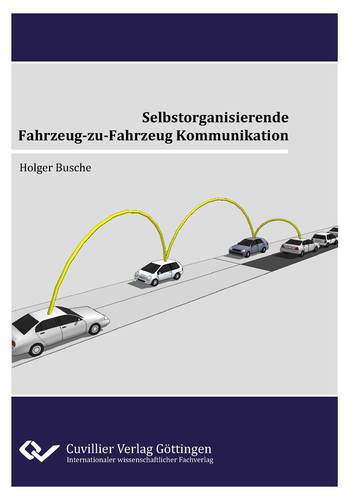
The Self-Organizing Traffic Information System (SOTIS) investigated here is based on vehicle-to-vehicle communication. In this system, every vehicle takes on the task of a mobile road sensor by measuring its own current driving speed. Each vehicle additionally contains a satellite navigation receiver, a digital map and a communication unit. This makes it possible to assign measured speeds to specific road segments and to transmit this message by radio to all road users in the local vicinity. By calculating the mean speed, a current traffic situation can already be determined quantitatively for each individual road segment. The investigations show that, with low vehicle equipment rates of ten percent, SOTIS receives traffic messages from a distance of fifty kilometres with a delay of ten minutes. The vehicle-to-vehicle based communication system thus outperforms conventional traffic information systems even in an introductory phase. In addition, the distribution of the vehicles makes it possible to determine traffic situations across the entire area.
The focus of this scientific work is the investigation of SOTIS communication at very high equipment rates. From this point of view, the radio channel is more heavily loaded because a large number of vehicles transmit data packets. In this case, traffic messages are received with very short delay times, even from great distances. The channel access protocol Carrier-Sense Multiple Access/Collision Avoidance (CSMA/CA) coordinates the inter-vehicle communication. Starting from a fixed system data rate, CSMA/CA can distribute channel access evenly among the vehicles at high traffic density. As the number of SOTIS vehicles increases, channel access can no longer be distributed evenly, and local overloads of the radio channel occur. As a result, SOTIS data packets are received with longer delay times and the traffic messages thus lose their timeliness. The aim is to control the channel load by adjusting the transmission power in each vehicle. To this end, every vehicle measures the local load of the radio channel. The channel load reflects the actual communication load of the CSMA/CA protocol, whereas the channel occupancy is determined directly by the number of vehicles.
To reduce the increased channel load, two methods for adapting a vehicle’s transmission power are investigated. Essentially, reducing the transmission power produces a smaller transmission and reception radius, which leads to a local reduction of the channel load. How a consistent adaptation of the transmission power across all vehicles can be achieved is one of the questions addressed. The self-organizing system behaviour poses the challenge for controlling the channel load. Both methods achieve a reduction of the channel load and a short SOTIS message delay. By adapting the transmission power, the radio channel of the vehicle-to-vehicle communication system is never overloaded.
| ISBN-13 (Hard Copy) | 9783954041701 |
| ISBN-13 (eBook) | 9783736941700 |
| Final Book Format | A5 |
| Language | German |
| Page Number | 186 |
| Lamination of Cover | matt |
| Edition | 1. Aufl. |
| Publication Place | Göttingen |
| Place of Dissertation | Hamburg-Harburg |
| Publication Date | 2012-07-30 |
| General Categorization | Dissertation |
| Departments |
Measurement and controlling engineering
Telecommunications and communications engineering |
| Keywords | Self-organisation, vehicle-to-vehicle, traffic information system, channel load |


