
Cuvillier Verlag GmbH



| Departments | |
|---|---|
| Book Series (99) |
1418
|
| Nachhaltigkeit |
3
|
| Gesundheitswesen |
3
|
| Humanities |
2418
|
| Medienwissenschaften | 17 |
| Theology | 57 |
| Philosophy | 103 |
| Law | 432 |
| Economics | 867 |
| Social sciences | 423 |
| Sports science | 48 |
| Psychology | 233 |
| Educational science | 190 |
| History | 194 |
| Art | 111 |
| Cultural studies | 168 |
| Literary studies | 119 |
| Linguistics | 91 |
| Natural Sciences |
5433
|
| Engineering |
1825
|
| Common |
97
|
|
Leitlinien Unfallchirurgie
5. Auflage bestellen |
|
Advanced Search
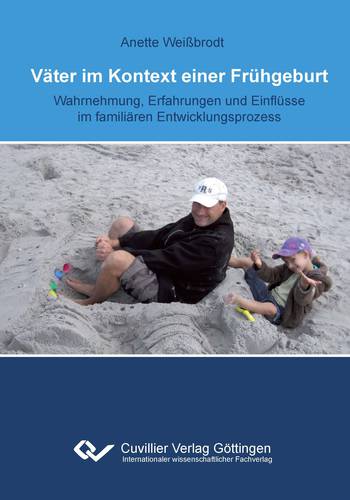
Väter im Kontext einer Frühgeburt (English shop)
Wahrnehmung, Erfahrungen und Einflüsse im familiären Entwicklungsprozess
Anette Weißbrodt (Author)Preview
Extract, PDF (60 KB)
Table of Contents, PDF (47 KB)
Families are regarded as the oldest institution of a society. Their structural forms and functions have changed considerably over the course of the centuries. The processes of change within families have essentially been indicated by socio-demographic and socio-cultural societal change. At present, a polar distribution of roles between mothers and fathers has largely been abolished. That is to say, the formerly closed system of mother and child has been loosened up, and fathers are involved to a greater extent in the care and upbringing of the children. At the end of the last century, the term ‘new fathers’ was coined. Numerous academic and popular publications have been devoted to this topic. Many studies have attempted to develop a classification of different types of fathers.
The development from the couple relationship (dyad) to the familial relationship triangle (triad) represents a profound biographical change. In the case of an uncomplicated pregnancy, the transition to parenthood proceeds in various phases that prepare for the birth. An illustrative phase model was developed by Gloger-Tippelt in 1985.
For parents of preterm infants, the process of adaptation is markedly shortened owing to the early birth. Long-lasting traumatising processes may subsequently occur. While mothers’ experience and coping with preterm birth has been the subject of several academic publications (e.g. Vonderlin 1999, Sarimski 2000), the psychodynamic coping process of fathers represents a little-researched field. Paternal emotional experience during pregnancy has to date been taken up mainly by psychoanalytic scholarship (Gambaroff 1990). Paternal experience during birth has been addressed in general terms (e.g. Schäfer et al. 2008); in the context of a preterm birth it was taken into account as a sub-study within a pilot study conducted by the Faculty of Medicine and the Faculty of Special Education at the University of Cologne. The samples were, however, small and permit generalisations only to a limited extent. Owing to its exploratory character, this pilot study has made an important contribution to the academic treatment of fathers of preterm infants. A study by Studer (2011) on father-child interaction in preterm infants was unable to demonstrate significant differences either in comparison with mother-child interaction or with father-child interaction in infants born at term. During the child’s inpatient stay, the father constitutes, in the triadic sense, an essential link between mother and child, particularly when the mother herself still requires medical care. In order not to reinforce feelings such as incompetence, failure or guilt in mothers, a sensitive approach is required when involving them in the early care and nursing of the preterm infant on the ward. Important measures to support interaction and the formation of attachment between father, mother and child during the hospital phase are developmentally supportive care (e.g. according to Heidelise Als), family-oriented neonatal medicine (e.g. according to the Stockholm model of Westrup) and psychological support.
Following discharge from hospital, intra- and interpsychic strategies of stress coping are of considerable importance and are shaped in an individual rather than a gender-specific manner. It should be noted, however, that fathers have a significant positive influence on the mother-child relationship in cases of postpartum mental illness in the mother. The favourable influence of fathers on the development of the preterm infant can be supported by psychotherapeutic accompaniment (e.g. according to the Ulm model of Brisch). Further studies (e.g. by Laucht/Schmidt) also point to the supportive behaviour of fathers with a protective effect in high-risk families. A study by Studer with a longitudinal approach investigated the effects of father-child interaction in preterm infants in comparison with mothers of preterm infants as well as in comparison with fathers of infants born at term. In comparison with the mothers, the fathers displayed an equally similar sensitivity in dealing with the infants. Nor could any significant differences in interaction with the infant be demonstrated in comparison with fathers of infants born at term.
In sum, fathers of preterm infants merit particular attention. On the one hand because fatherhood has changed considerably over recent years, and on the other because the special significance of the father in the context of a preterm birth yields important insights for dealing with and caring for parents and their preterm infants. Current findings thus underline the influential significance of fathers within the overall familial context, between stabilisation of the family and coping in the aftermath of a preterm birth.
Anette Weißbrodt, born 1967, educationalist/Master of Arts in Social Work/FH Potsdam. Studies in the departments of Educational Science, Sport Science and German Studies/University of Kassel, health educationalist (DGG e.V.), qualified paediatric nurse. Since 1997 at the Social Paediatric Centre at Klinikum Kassel in the follow-up care of preterm infants.
| ISBN-13 (Hard Copy) | 9783954042180 |
| ISBN-13 (eBook) | 9783736942189 |
| Final Book Format | A5 |
| Language | German |
| Page Number | 134 |
| Lamination of Cover | matt |
| Edition | 1. Aufl. |
| Publication Place | Göttingen |
| Publication Date | 2012-09-14 |
| General Categorization | Diploma |
| Departments |
Psychology
Educational science Human medicine |
| Keywords | Premature infants, fathers, couple relationship, parental care, parental support, attachment, neonatology, general education, paediatrics |


