
Cuvillier Verlag GmbH



| Departments | |
|---|---|
| Book Series (99) |
1418
|
| Nachhaltigkeit |
3
|
| Gesundheitswesen |
3
|
| Humanities |
2418
|
| Natural Sciences |
5433
|
| Engineering |
1825
|
| Engineering | 292 |
| Mechanical and process engineering | 875 |
| Electrical engineering | 701 |
| Mining and metallurgy | 30 |
| Architecture and civil engineering | 76 |
| Common |
97
|
|
Leitlinien Unfallchirurgie
5. Auflage bestellen |
|
Advanced Search
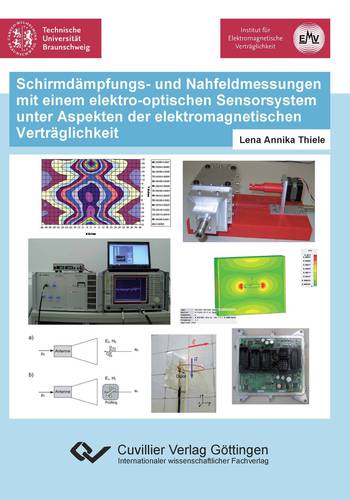
Schirmdämpfungs- und Nahfeldmessungen mit einem elektro-optischen Sensorsystem unter Aspekten der elektromagnetischen Verträglichkeit (English shop)
Lena Annika Thiele (Author)Preview
Extract, PDF (100 KB)
Table of Contents, PDF (41 KB)
Abstract
Measuring electromagnetic field strengths in the near-field region of antennas is a fundamental measurement task. Equally important is the measurement of the shielding effectiveness of small shielding enclosures, some of which are equipped with printed circuit boards. The field probes used must, on the one hand, be very small in order to allow measurements even where space is restricted. On the other hand, they must exhibit high sensitivity and accuracy in order to ensure a sufficient measurement dynamic range. Particularly in the case of very well shielded enclosures, it must still be possible to determine the field strength inside. In addition, the field properties present and to be investigated must not be altered at all, or only to a very small extent, by the sensors introduced.
The lithium niobate-based electro-optical sensor presented in this work has very small dimensions and operates entirely passively. Apart from a small metallic dipole serving as the receiving structure, the transducer consists solely of dielectric materials. These properties make it well suited to being introduced even into enclosures with very limited space.
In the present work, the theoretical and physical fundamentals are developed first. In addition, the measurement system used and the different measurement environments are explicitly presented. Subsequently, it is investigated whether the sensor presented is in principle suitable for field strength measurement in the near field. Particular attention is paid to sensitivity, but also to the low back scattering effect on the original electric field. For this purpose, near-field measurements on a double-ridged horn antenna are shown and compared with theoretical values from the literature. In a second step, the near-field data are transformed and compared with far-field measurements of the horn antenna. All data show very good agreement.
The focus of this work is on the actual shielding effectiveness measurements. For this purpose, current methods and standards are first presented. Then, as a first step, measurements on a simple shielding enclosure are shown in order to determine the most important coupling mechanisms. These show very good agreement with simulation results generated with CST MICROWAVE STUDIO®. Building on these results, further measurements on a real shielding enclosure for engine control units are presented. Both the empty enclosure and the enclosure equipped with a printed circuit board are measured. It is furthermore shown that the sensitivity of the sensor can be significantly increased by simple modifications. Further consequences of these modifications are likewise determined. Subsequently, the effects of different loadings of the enclosure on its shielding effect are determined. The work closes with an outlook on possible magnetic field measurements with the electro-optical sensor system and first measurement results for this application.
Abstract
Near-field measurements of antennas or other radiating structures are a challenging technique for determining their far-field patterns. Shielding effectiveness measurements especially of small enclosures are as well an important task for the electro-magnetic compatibility (EMC) of running systems. These near-field measurements need to be done without influencing the actual field distribution. Thus a small field probe with very little back scattering effect is required.
In this work a lithiumniobate-based electro-optical field sensor with good sensitivity is shown, which is suitable not only for antenna measurements but also for small devices, where testing power is limited. Interferences to the field distribution are minimized, due to the absence of any conductive material for power supply and measurement signal transmission, which are realized with a fiber optic cable. The sensor itself as well consists of only nonmetallic parts except for two thin and short wires constituting an infinitesimal electric dipole as the receiving structure, the received voltage being applied to the electro optical lithiumniobate modulator.
Initially the theoretical and physical background of the realized measurements is given. Especially the used sensor system and the measurement environments are shown in detail. Afterwards the functionality and accuracy of the sensor system is demonstrated with an aperture scan of a large horn antenna. Measurements correspond well to the known theoretical description of the electric field. Additionally, far-field transforms of the measured data show a good agreement with direct far-field measurements performed at an open area test site.
The main topics of this work are the shielding-effectiveness measurements of small enclosures. Therefore relevant standards and techniques are presented. Afterwards a simple metallic rectangular enclosure which provides variable slot sizes is used as a reference object. Measurements with such an enclosure should give insight into basic coupling mechanisms, but also provide fundamental data for EMC-considerations. The results of the measurements are compared with the simulations of the electric field. For the simulation the program MICROWAVE STUDIO® is used. As a second step measurements with a common motorcontrol unit enclosure are provided. Measurements take place in two different measurement environments. Furthermore the sensor is used in various configurations according to the dynamic range and the usability of these modifications is studied and described.
The work closes with an outlook to future measurements scenarios for measuring the magnetic field strength with the provided electro-optical field sensor.
| ISBN-13 (Hard Copy) | 9783954042326 |
| ISBN-13 (eBook) | 9783736942325 |
| Final Book Format | A5 |
| Language | German |
| Page Number | 152 |
| Lamination of Cover | glossy |
| Edition | 1. Aufl. |
| Publication Place | Göttingen |
| Place of Dissertation | Braunschweig |
| Publication Date | 2012-09-19 |
| General Categorization | Dissertation |
| Departments |
Electrical engineering
|
| Keywords | General electrical engineering, shielding effectiveness, near-field measurements, electro-optical sensor |


