
Cuvillier Verlag GmbH



| Departments | |
|---|---|
| Book Series (99) |
1415
|
| Nachhaltigkeit |
3
|
| Gesundheitswesen |
3
|
| Humanities |
2411
|
| Natural Sciences |
5429
|
| Engineering |
1821
|
| Engineering | 292 |
| Mechanical and process engineering | 872 |
| Electrical engineering | 700 |
| Mining and metallurgy | 30 |
| Architecture and civil engineering | 76 |
| Common |
97
|
|
Leitlinien Unfallchirurgie
5. Auflage bestellen |
|
Advanced Search
Miniaturmessverfahren insbesondere Nanoindentation zur Bestimmung von Materialparametern bei kleinen Werkstoffmengen (Volume 7) (English shop)
Holger Worrack (Author)Preview
Extract, PDF (190 KB)
Table of Contents, PDF (45 KB)
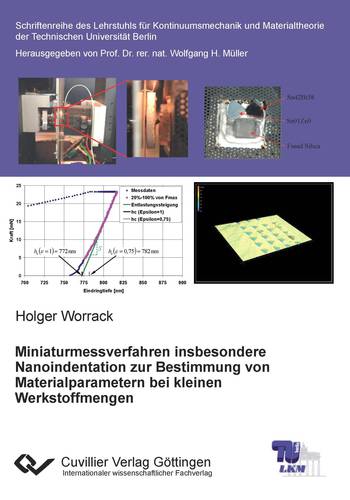
Nanoindentation is a common and widely used measurement principle in materials research. It is a modified variant of the classical instrumented indentation test. Owing to the low forces and the small dimensions of the indenter, this method can be applied to the smallest structures with dimensions in the submicron range. Characteristic of instrumented indentation testing is the recording of the entire loading history. In addition to the hardness value, which is determined as a fundamental quantity from an indentation test, this method allows further material parameters to be determined. Foremost among these is the modulus of elasticity. At the Chair of Continuum Mechanics and Materials Theory (LKM) of the Technische Universität Berlin, the nanoindenter has already been in successful use for several years. As an introduction to the topic and to the fields of application of nanoindentation, the fundamentals of hardness measurement are explained in detail at the beginning. In this context, the most common hardness testing methods are clearly described and the assumptions and equations required for carrying out the measurements and for evaluating the measurement data are presented.
Within the scope of the present work, however, a further step is taken with regard to the flexibility of the nanoindentation system. The existing basic setup is extended by a heating device, thereby allowing measurements to be carried out between room temperature and +500 °C. Measurements at elevated temperature require a fundamental investigation of the actual indentation temperature at the specimen surface. For this purpose, temperature measurements using a thermal imaging camera and thermocouples are presented within the scope of this work and are additionally compared with finite element simulations. In this way, a general material-specific statement is to be made about the surface temperatures as a function of the values specified by the user.
This is followed by initial temperature-influenced indentations on the calibration material fused silica. In this way, the quality and reproducibility of the measurements can be analysed. The elastic modulus values determined by nanoindentation as a function of temperature show very good agreement with several reference data. Furthermore, successful temperature-dependent measurements on the material Cu-HCP follow. Since the LKM has for years been engaged in the material-theoretical investigation of solder materials from the electronics industry, the temperature-dependent nanoindentation method is further applied to the two lead- and silver-free solder materials Sn42Bi58 and Sn91Zn9. These low-melting solder alloys tend to exhibit increased time-dependent plastic deformation. This so-called strongly temperature-dependent creep behaviour is, however, already observed in the aforementioned materials even in room-temperature measurements. This time-dependent material deformation changes the shape of the recorded measurement curve and complicates the automated evaluation performed by the nanoindenter, which relies on important assumptions regarding a characteristic force–indentation depth curve. To avoid these effects, it is shown that, among other things, an extension of the holding time at constant indentation force, which occurs between loading and unloading in every test, has a positive influence on the curve shape and accordingly on the evaluation results. On the basis of these findings, the material data determined for the two solders by means of the modified procedure are presented and guide values for the holding times during measurement are specified.
In addition to the values for hardness and modulus of elasticity, research is pursuing the path of extended evaluation of nanoindentation tests. In this context, the question is discussed of the extent to which the method is suitable for determining, in addition to the aforementioned elastic parameters, also plastic or viscous characteristic values. For this purpose, a method from the literature [Dao et al., 2001] is applied to the present measurements in this work and partially modified with regard to the evaluation procedure and methodology. On the basis of this evaluation procedure it is possible to obtain, for the solder materials, in addition to the Young’s modulus and hardness values, good estimates for the plastic parameters yield stress and hardening exponent. Moreover, good values are also obtained for the industrially widespread aluminium material AA6016T4. Future research in this direction could lead to further optimisation of the evaluation possibilities as well as to a possible automation of the presented method and its extension to a larger number of materials.
The creep tendency already addressed above is, in conclusion, the subject of an outlook on an likewise extended evaluation by means of rheological models. Spring–dashpot substitute models are frequently used in materials research for the theoretical description of material deformation behaviour. For this reason, the basic rheological elements are presented in a clearly arranged manner and the resulting differential stress–strain equations for arrangements of two and three basic elements are derived. The application of these substitute systems to nanoindentation is discussed, among others, in [Menčík et al., 2009]. The equations and analysis steps developed in that work presuppose certain requirements regarding the loading time. For this reason, a large number of measurements are again carried out and evaluated. The evaluations consider exclusively the holding phase, i.e. the creep region of the measurement curve. The presented equations, or rather the material parameters entering the equations, must be varied within the evaluation until the theoretical description of the creep curve agrees as closely as possible with the experimental measurement curve. This optimisation problem is also referred to as inverse analysis. Among the parameters to be adjusted is the modulus of elasticity. The evaluation shows that for materials with a high elastic proportion of the total deformation, the inverse calculation yields very good results with regard to the Young’s modulus. For copper and SnBi solder, which exhibit only a small elastic deformation proportion, the method with the substitute model used here is unsuitable. In theory, however, there are no limits to the combination of spring and dashpot elements. It must be worked out in the future which rheological arrangements are best suited to describe increased plastic material behaviour with sufficient accuracy.
| ISBN-13 (Hard Copy) | 9783954042401 |
| ISBN-13 (eBook) | 9783736942400 |
| Final Book Format | A5 |
| Language | German |
| Page Number | 208 |
| Lamination of Cover | matt |
| Edition | 1. Aufl. |
| Book Series | Schriftenreihe des Lehrstuhls für Kontinuumsmechanik und Materialtheorie der Technischen Universität Berlin |
| Volume | 7 |
| Publication Place | Göttingen |
| Place of Dissertation | Berlin |
| Publication Date | 2012-10-01 |
| General Categorization | Dissertation |
| Departments |
Engineering
|
| Keywords | Engineering Mechanics, Fluid Mechanics, Thermodynamics |


