
Cuvillier Verlag GmbH



| Departments | |
|---|---|
| Book Series (99) |
1415
|
| Nachhaltigkeit |
3
|
| Gesundheitswesen |
3
|
| Humanities |
2412
|
| Medienwissenschaften | 17 |
| Theology | 57 |
| Philosophy | 103 |
| Law | 430 |
| Economics | 863 |
| Social sciences | 423 |
| Sports science | 48 |
| Psychology | 233 |
| Educational science | 190 |
| History | 194 |
| Art | 111 |
| Cultural studies | 168 |
| Literary studies | 119 |
| Linguistics | 91 |
| Natural Sciences |
5430
|
| Engineering |
1821
|
| Common |
97
|
|
Leitlinien Unfallchirurgie
5. Auflage bestellen |
|
Advanced Search
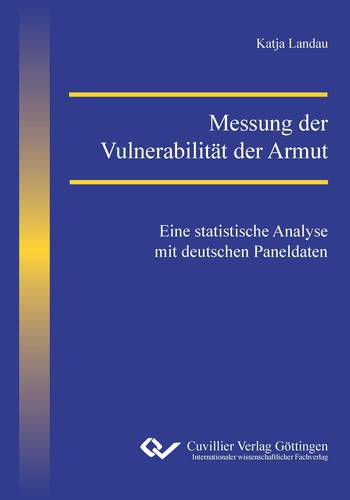
Messung der Vulnerabilität der Armut (English shop)
Katja Landau (Author)Preview
Extract, PDF (240 KB)
Table of Contents, PDF (47 KB)
Summary
In order to combat poverty, it is important not only to identify households that are poor, but also those that are at risk of becoming poor. This study assesses the accuracy of predictions of the risk of income poverty, referred to as vulnerability to poverty, on the basis of cross-sectional and panel data. German panel data (the German Socio-Economic Panel, SOEP) are used for the analysis. The prediction of whether households are vulnerable to poverty or not is based on regression models with different covariates (household characteristics or groups of households, continuous income or income in classes, macro variables). The accuracy of the predictions is measured using the Receiver Operating Characteristic (ROC), which takes into account not only the share of correctly identified poor households (True Positive Rate, TPR) but also the share of households incorrectly classified as vulnerable to poverty (False Positive Rate, FPR). The estimators based on cross-sectional data are less accurate than those based on panel data. This is also the case when only income in two classes is used for the estimation. For Germany, the accuracy of vulnerability estimators is limited even when panel data are available. The reasons for this are the low poverty rate and the high mobility of households into and out of poverty.
Abstract
In order to reduce poverty it is clearly of interest to identify, not only those households that are poor, but also those that are at risk of becoming poor, i.e. vulnerable to poverty. In this research, the accuracy of the ex ante assessments of vulnerability to income poverty is investigated using cross-sectional and panel data. For this purpose, long-term panel data from Germany (the German Socio-Economic Panel, SOEP) are used and different regression models are applied to classify whether a household is vulnerable or not. These models include various covariates (household covariates or groups according to household characteristics, continuous or discrete previous-year-income, macro covariates). Predictive performance is assessed using the Receiver Operating Characteristic (ROC), which takes account of true positive as well as false positive rates. Estimates based on cross-sectional data are less accurate than those based on panel data. This is true even if only imprecise information about income, i.e. classification of households into two income groups, are known. In the case of Germany, the accuracy of vulnerability predictions is limited even when panel data are used. In part this low accuracy is due to low poverty incidence and high mobility in and out of poverty.
| ISBN-13 (Hard Copy) | 9783954042586 |
| ISBN-13 (eBook) | 9783736942585 |
| Final Book Format | A5 |
| Language | German |
| Page Number | 244 |
| Lamination of Cover | matt |
| Edition | 1. Aufl. |
| Publication Place | Göttingen |
| Place of Dissertation | Göttingen |
| Publication Date | 2012-10-26 |
| General Categorization | Dissertation |
| Departments |
Economics
|
| Keywords | Poverty, German panel data, ROC, Vulnerability |


