
Cuvillier Verlag GmbH



| Departments | |
|---|---|
| Book Series (99) |
1415
|
| Nachhaltigkeit |
3
|
| Gesundheitswesen |
3
|
| Humanities |
2412
|
| Natural Sciences |
5430
|
| Engineering |
1821
|
| Engineering | 292 |
| Mechanical and process engineering | 872 |
| Electrical engineering | 700 |
| Mining and metallurgy | 30 |
| Architecture and civil engineering | 76 |
| Common |
97
|
|
Leitlinien Unfallchirurgie
5. Auflage bestellen |
|
Advanced Search
Analyse der Entwicklungsstufen des Carbonate Looping Prozesses zur CO2-Abscheidung (English shop)
Johannes Kremer (Author)Preview
Table of Contents, PDF (46 KB)
Extract, PDF (130 KB)
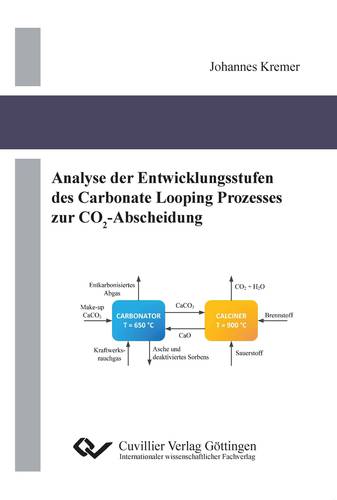
CO2 capture from the flue gases of fossil-fired power plants and subsequent geological storage or material utilisation can make an important contribution to reducing energy-related CO2 emissions. The post-combustion CCS technology carbonate looping in particular offers very great potential in this respect. In addition to very effective and efficient CO2 capture, heat from the material streams of the carbonate looping process can be used for steam and electricity generation.
Results obtained in particular in experimental carbonate looping investigations with continuous CO2 capture in a 1 MWth test facility at the Technische Universität Darmstadt form the basis for the further development of this CCS process. The design and realisation of a pilot plant in which, alongside CO2 capture from a partial stream of the flue gas of a coal-fired power plant, thermal integration between the carbonate looping plant and the upstream power plant is implemented, represents the next stage in the development of carbonate looping technology. Taking the parameters of operational variability and operational flexibility into account, the pilot plant is initially designed at the expense of energetic optimisation. By means of material and energy balances, the effects of numerous influencing factors on the carbonate looping process and on electricity generation in the upstream power plant are investigated for various load cases. Through the elaboration of optimisation options for the pilot plant, optimisation variants are proposed and their influence on the processes in the carbonate looping pilot plant and in the upstream power plant is analysed. In order to be able to conclusively assess the effect of CO2 capture by carbonate looping on the efficiency of the upstream power plant, the next step, based on selected optimisation variants, is to investigate CO2 capture from the complete flue gas stream of two different coal-fired power plants.
An innovative application of carbonate looping technology is CO2 capture from the flue gases of waste incineration plants. In addition to reducing CO2 emissions from waste incineration, carbonate looping can help to improve the efficiency of electricity generation from waste. This potential is investigated for different fuels in the calciner and various thermal integration configurations.
| ISBN-13 (Hard Copy) | 9783954046584 |
| ISBN-13 (eBook) | 9783736946583 |
| Final Book Format | A5 |
| Language | German |
| Page Number | 218 |
| Lamination of Cover | matt |
| Edition | 1. Aufl. |
| Publication Place | Göttingen |
| Place of Dissertation | Darmstadt |
| Publication Date | 2014-03-14 |
| General Categorization | Dissertation |
| Departments |
Mechanical and process engineering
|
| Keywords | CCS (Carbon Capture and Storage), CO2 capture, CO2 separation, carbonate looping, power plant, fossil, low-CO2, flue gas cleaning, limestone, hard coal, carbon dioxide, thermal waste treatment, environmental engineering, general process engineering |


