
Cuvillier Verlag GmbH



| Departments | |
|---|---|
| Book Series (99) |
1415
|
| Nachhaltigkeit |
3
|
| Gesundheitswesen |
3
|
| Humanities |
2412
|
| Natural Sciences |
5430
|
| Engineering |
1821
|
| Engineering | 292 |
| Mechanical and process engineering | 872 |
| Electrical engineering | 700 |
| Mining and metallurgy | 30 |
| Architecture and civil engineering | 76 |
| Common |
97
|
|
Leitlinien Unfallchirurgie
5. Auflage bestellen |
|
Advanced Search
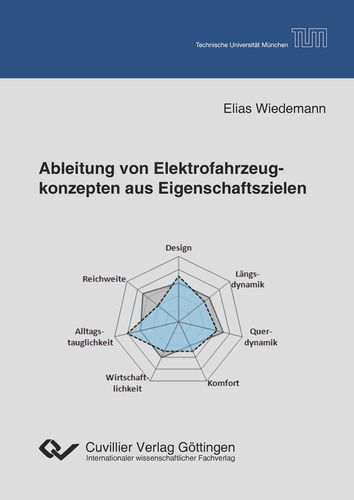
Ableitung von Elektrofahrzeugkonzepten aus Eigenschaftszielen (English shop)
Elias Wiedemann (Author)Preview
Table of Contents, PDF (63 KB)
Extract, PDF (230 KB)
The aim of this work is to support the developer in the attribute-oriented concept design of electric vehicles. An abstracted development process makes it possible, on the basis of strategically defined attribute targets, to automatically generate the best possible electric vehicle concept. The simulation models developed for this purpose to evaluate the objectifiable attributes of electric vehicles are described in detail. Classical design of experiments with intelligent solution space delimitation as well as algorithm-based optimisers are used to determine the vehicle with the highest concept quality. The plausibility as well as the diverse application possibilities of the developed approach are illustrated using the example of the optimisation results for an electric city vehicle.
| ISBN-13 (Hard Copy) | 9783954047895 |
| ISBN-13 (eBook) | 9783736947894 |
| Final Book Format | A5 |
| Language | German |
| Page Number | 218 |
| Lamination of Cover | glossy |
| Edition | 1. Aufl. |
| Publication Place | Göttingen |
| Place of Dissertation | TU München |
| Publication Date | 2014-09-01 |
| General Categorization | Dissertation |
| Departments |
Mechanical and process engineering
|
| Keywords | Electric vehicle, optimization, properties, customer orientation, House of Quality, automotive engineering |


