
Cuvillier Verlag GmbH



| Departments | |
|---|---|
| Book Series (99) |
1415
|
| Nachhaltigkeit |
3
|
| Gesundheitswesen |
3
|
| Humanities |
2411
|
| Natural Sciences |
5429
|
| Engineering |
1821
|
| Engineering | 292 |
| Mechanical and process engineering | 872 |
| Electrical engineering | 700 |
| Mining and metallurgy | 30 |
| Architecture and civil engineering | 76 |
| Common |
97
|
|
Leitlinien Unfallchirurgie
5. Auflage bestellen |
|
Advanced Search
Technisch-wirtschaftliche Systembetrachtung zur netzorientierten Integration von Mini-Blockheizkraftwerken (English shop)
Magnus Pielke (Author)Preview
Table of Contents, Datei (47 KB)
Extract, Datei (48 KB)
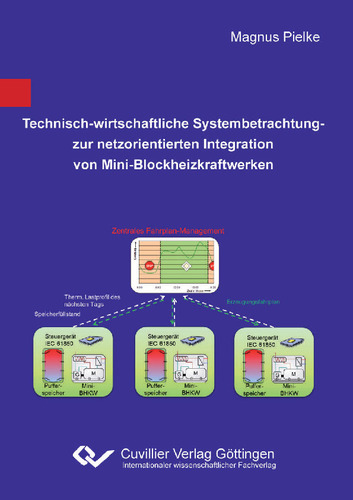
This work provides a technical and economic system analysis of the integration of mini combined heat and power plants (mini-CHP) used for domestic energy supply into the public electricity supply grid. Within the scope of this investigation, the significance of decentralised energy conversion by mini-CHP units for the public electricity supply is analysed and its influence on the operation of electrical distribution grids is quantified. Building on this, a grid-oriented networked operation is presented which, in addition to supplying energy to residential buildings, also takes into account the requirements of the electrical distribution grid.
On the basis of an assessment of the market potential for mini-CHP units for domestic energy supply in Germany, scenarios can be derived that describe various degrees of market penetration. The simulation of CHP operation is based, on the one hand, on measurement data from local distribution transformers and, on the other, on probabilistic load profiles for electrical energy as well as for space heating and domestic hot water. The simulation is thus able to describe the effects of decentralised energy conversion in the supply grid and in domestic energy supply on the basis of key indicators.
The comparison of the integration strategy developed here with heat-led CHP operation is carried out not only from a technical but also from an economic perspective. In this context, the operating mode is assessed using the dynamic net present value method. Various monetary incentive systems are presented to motivate the grid-oriented operating mode and are subsequently evaluated technically and economically.
The results of the economic investigations further provide approaches for the development of business models for grid-oriented networked CHP operation. The various market participants that appear suitable as operators are discussed and the procedure for implementing energy supply contracting in the housing industry is described.
The results show that the networked CHP operation presented offers major advantages over heat-led operation, both technically and economically. However, the discussion of the legal framework shows that implementing this approach on the basis of energy supply contracting requires an adjustment of the current funding guidelines as well as a clarification and alignment of the legal situation in the housing and energy sectors.
| ISBN-13 (Printausgabe) | 3869553529 |
| ISBN-13 (Hard Copy) | 9783869553528 |
| ISBN-13 (eBook) | 9783736933521 |
| Language | German |
| Page Number | 158 |
| Edition | 1 Aufl. |
| Volume | 0 |
| Publication Place | Göttingen |
| Place of Dissertation | TU Braunschweig |
| Publication Date | 2010-07-05 |
| General Categorization | Dissertation |
| Departments |
Electrical engineering
|


