
Cuvillier Verlag GmbH



| Departments | |
|---|---|
| Book Series (99) |
1415
|
| Nachhaltigkeit |
3
|
| Gesundheitswesen |
3
|
| Humanities |
2411
|
| Medienwissenschaften | 17 |
| Theology | 57 |
| Philosophy | 103 |
| Law | 430 |
| Economics | 863 |
| Social sciences | 423 |
| Sports science | 48 |
| Psychology | 233 |
| Educational science | 190 |
| History | 194 |
| Art | 111 |
| Cultural studies | 167 |
| Literary studies | 118 |
| Linguistics | 91 |
| Natural Sciences |
5429
|
| Engineering |
1821
|
| Common |
97
|
|
Leitlinien Unfallchirurgie
5. Auflage bestellen |
|
Advanced Search
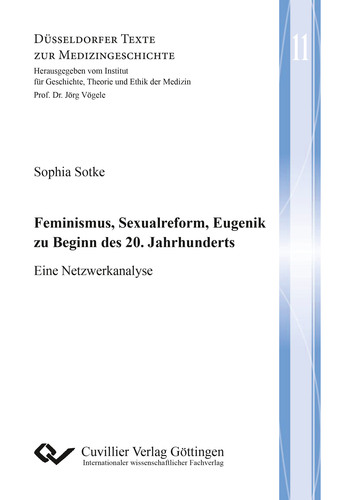
Feminismus, Sexualreform, Eugenik zu Beginn des 20. Jahrhunderts (Volume 11) (English shop)
Eine Netzwerkanalyse
Sophia Sotke (Author)Preview
Preface, PDF (38 KB)
Table of Contents, PDF (35 KB)
Extract, PDF (66 KB)
In 1905, the Bund für Mutterschutz was founded in Berlin as an initiative of the radical wing of the women’s movement that had formed in Germany since the mid-nineteenth century. Its aims were to improve the social situation of unmarried mothers and their children and to revolutionise the prevailing sexual morality. Helene Stöcker, the League’s leading theorist, fought for women’s self-determination and advocated the right to contraception and the legalisation of abortion. As the goal of her sex-reformist ethics of love, Helene Stöcker postulated not only equal rights for men and women, but also an “elevation and ennoblement of humanity”. She held eugenic positions that were espoused at the same time by the Gesellschaft für Rassenhygiene as well. Nevertheless, it appears contradictory that the radical sexual reformers around Helene Stöcker identified with the racial-hygienic worldview. The former fought for the sexual liberation of women, while the latter reduced the female sex, in the sense of the “purpose of the species”, to the role of mother and wife. Helene Stöcker’s ideas were taken up again in the second German women’s movement of the 1970s, whereas aspects of racial-hygienic thought were invoked after 1933 to legitimise racial laws, forced sterilisations and further inhumane measures. Because of this contradictoriness, eugenic thought in the feminist sexual reform of the late Kaiserreich and the Weimar Republic has occupied research for over 30 years. Sophia Sotke’s work makes a new contribution to this research by undertaking a network analysis of feminism, sexual reform and eugenics between 1905 and 1914.
| ISBN-13 (Hard Copy) | 9783736993563 |
| ISBN-13 (eBook) | 9783736983564 |
| Final Book Format | A5 |
| Language | German |
| Page Number | 132 |
| Edition | 1. Aufl. |
| Book Series | Düsseldorfer Texte zur Medizingeschichte |
| Volume | 11 |
| Publication Place | Göttingen |
| Publication Date | 2016-10-10 |
| General Categorization | Non-Fiction |
| Departments |
Modern history
History of science and technology |


