
Cuvillier Verlag GmbH



| Departments | |
|---|---|
| Book Series (99) |
1412
|
| Nachhaltigkeit |
3
|
| Gesundheitswesen |
3
|
| Humanities |
2402
|
| Medienwissenschaften | 16 |
| Theology | 57 |
| Philosophy | 103 |
| Law | 427 |
| Economics | 862 |
| Social sciences | 423 |
| Sports science | 48 |
| Psychology | 233 |
| Educational science | 190 |
| History | 190 |
| Art | 111 |
| Cultural studies | 167 |
| Literary studies | 117 |
| Linguistics | 90 |
| Natural Sciences |
5427
|
| Engineering |
1818
|
| Common |
97
|
|
Leitlinien Unfallchirurgie
5. Auflage bestellen |
|
Advanced Search
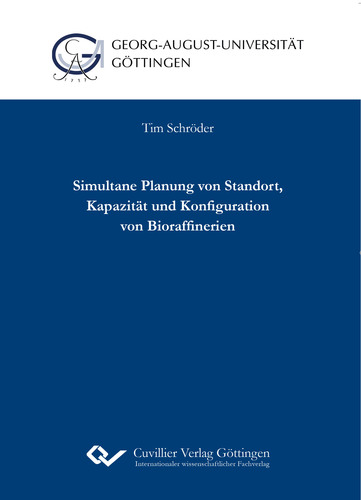
Simultane Planung von Standort, Kapazität und Konfiguration von Bioraffinerien (English shop)
Tim Schröder (Author)Preview
Table of Contents, PDF (100 KB)
Extract, PDF (260 KB)
Unter dem Begriff Bioraffinerien werden verschiedene innovative technologische Konzepte zusammengefasst, die aus nachwachsenden Rohstoffen eine Palette an energetischen, stofflichen und pharmazeutischen Produkten herstellen können, die derzeit aus fossilen Ressourcen gewonnene Produkte direkt oder indirekt ersetzen. Um die vorhandenen nachwachsenden Rohstoffe möglichst effizient zu nutzen und Konkurrenzen zu anderen Anwendungen, insbesondere der Nahrungsmittelproduktion, zu vermeiden, werden in dieser Arbeit Restbiomassen als Einsatzstoff für Bioraffinerien untersucht. Da Restbiomassen nur mit vergleichsweise geringen spezifischen Erträgen zur Verfügung stehen, wird deren geografischer Anfall mit Hilfe von Geoinformationssystemen (GIS) in der strategischen Planung von Bioraffinerien einbezogen. Ziel dieser Arbeit ist folglich die strategische Planung einer Bioraffinerie unter Berücksichtigung des geografischen Biomassenanfalls. Dadurch ergibt sich ein komplexes Entscheidungsproblem, in dem Standort, Kapazität und Konfiguration der Anlage in Wechselwirkung zueinander stehen und simultan zu optimieren sind.
Dazu wird ein hybrider Algorithmus aus einer übergeordneten heuristischen Evolutionsstrategie mit einem eingebetteten exakten nichtlinearen Programm entwickelt. Dieses Vorgehen ermöglicht erstmals die simultane Planung von Standort, Kapazität und Konfiguration von Bioraffinerien unter Berücksichtigung des geografischen Anfalls der Restbiomassen mit verschiedenen Bioraffinerietechnologien und in unterschiedlichen Regionen. Das entwickelte Entscheidungsmodell wird in zwei Fallstudien zur Planung einer Fischer-Tropsch-Bioraffinerie in Deutschland und einer Lignocellulose-Bioraffinerie im Cariboo District in British Columbia, Kanada, angewendet.
| ISBN-13 (Hard Copy) | 9783736995796 |
| ISBN-13 (eBook) | 9783736985797 |
| Final Book Format | A5 |
| Language | German |
| Page Number | 238 |
| Edition | 1. |
| Publication Place | Göttingen |
| Place of Dissertation | Göttingen |
| Publication Date | 2017-07-10 |
| General Categorization | Dissertation |
| Departments |
Economics
Business economics Statistics and operations research, business mathematics |
| Keywords | Bioraffinerien, Bioökonomie, Restbiomasse, strategische Planung, Metaheuristik, Evolutionsstrategien, Matheuristik, nichtlineare Optimierung, NLP, Hybrider Algorithmus, Fischer-Tropsch-Synthese, Lignocellulose-Bioraffinerie |


