
Cuvillier Verlag GmbH



| Departments | |
|---|---|
| Book Series (99) |
1415
|
| Nachhaltigkeit |
3
|
| Gesundheitswesen |
3
|
| Humanities |
2410
|
| Natural Sciences |
5428
|
| Mathematics | 229 |
| Informatics | 320 |
| Physics | 982 |
| Chemistry | 1371 |
| Geosciences | 131 |
| Human medicine | 246 |
| Stomatology | 10 |
| Veterinary medicine | 112 |
| Pharmacy | 147 |
| Biology | 837 |
| Biochemistry, molecular biology, gene technology | 121 |
| Biophysics | 25 |
| Domestic and nutritional science | 45 |
| Agricultural science | 1005 |
| Forest science | 201 |
| Horticultural science | 20 |
| Environmental research, ecology and landscape conservation | 148 |
| Engineering |
1820
|
| Common |
97
|
|
Leitlinien Unfallchirurgie
5. Auflage bestellen |
|
Advanced Search
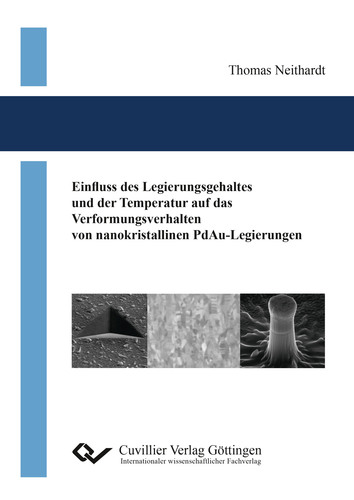
Einfluss des Legierungsgehaltes und der Temperatur auf das Verformungsverhalten von nanokristallinen PdAu-Legierungen (English shop)
Thomas Neithardt (Author)Preview
Table of Contents, PDF (51 KB)
Extract, PDF (300 KB)
Nanocrystalline metals (grain size D < 100 nm) are an attractive alternative to conventional metallic materials due to their enhanced mechanical strength. In order to exploit this property, an understanding of the mechanisms activated during deformation is necessary. The increase in mechanical strength is brought about by the impediment of conventional dislocation plasticity as a result of the reduced grain size. Consequently, other deformation mechanisms become dominant. Mechanisms discussed in the literature include grain boundary sliding, grain rotation and grain alignment, stress-induced grain growth, twinning, as well as complex grain boundary and dislocation interaction.
In this work, the deformation behaviour of nanocrystalline PdAu alloys with a mean grain size of approx. 30 nm was investigated. The influence of strain rate, alloy content and temperature was considered. For this purpose, the mechanical properties were examined by means of nanoindentation and micro-compression tests. The microstructural changes during deformation were analysed on transmission electron microscopy images of sample cross-sections prepared with the focused ion beam microscope.
A pronounced strain rate sensitivity was observed for the nanocrystalline PdAu alloys. The alloy content and the temperature each show an influence on the hardness, but not on the strain rate sensitivity. In the microstructure, the pronounced (111) textures present in the samples dissolved, and a change in grain size and grain shape occurred. This indicates a deformation mechanism based on dislocation motion and the interaction between grain boundaries and dislocations. At higher degrees of deformation, stress-induced grain growth occurs, leading to a softening of the material behaviour.
| ISBN-13 (Hard Copy) | 9783736996076 |
| ISBN-13 (eBook) | 9783736986077 |
| Final Book Format | A5 |
| Language | German |
| Page Number | 134 |
| Lamination of Cover | matt |
| Edition | 1. Aufl. |
| Publication Place | Göttingen |
| Place of Dissertation | Karlsruhe |
| Publication Date | 2017-08-11 |
| General Categorization | Dissertation |
| Departments |
Physics
Mechanical and process engineering |
| Keywords | nanocrystalline metals, deformation mechanisms, nanocrystalline PdAu alloys, strain rate, alloying content, temperature, nanoindentation, micro-compression test |


