
Cuvillier Verlag GmbH



| Departments | |
|---|---|
| Book Series (99) |
1415
|
| Nachhaltigkeit |
3
|
| Gesundheitswesen |
3
|
| Humanities |
2411
|
| Medienwissenschaften | 17 |
| Theology | 57 |
| Philosophy | 103 |
| Law | 430 |
| Economics | 863 |
| Social sciences | 423 |
| Sports science | 48 |
| Psychology | 233 |
| Educational science | 190 |
| History | 194 |
| Art | 111 |
| Cultural studies | 167 |
| Literary studies | 118 |
| Linguistics | 91 |
| Natural Sciences |
5429
|
| Engineering |
1821
|
| Common |
97
|
|
Leitlinien Unfallchirurgie
5. Auflage bestellen |
|
Advanced Search
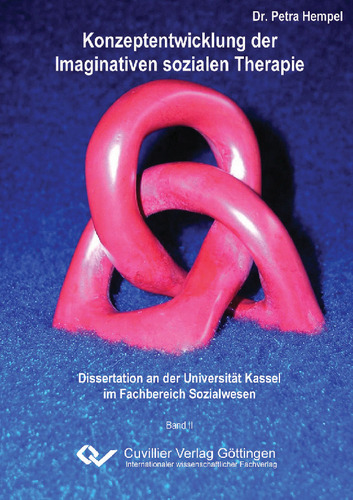
Konzeptentwicklung der Imaginativen sozialen Therapie (English shop)
Petra Hempel (Author)Preview
Table of Contents, Datei (47 KB)
Extract, Datei (77 KB)
Imaginative Social Therapy was developed out of counselling work in social pedagogy. It is a direct, intervention-oriented method with elements of case-related and primary-group-related methods (including social casework, socio-pedagogical counselling, client-centred counselling) and is combined with elements of group-related and social-space-related methods. Furthermore, it is a multidimensional method that integratively incorporates, among others, imaginative, cognitive, psychotherapeutic and behavioural-therapeutic elements in modified or abbreviated form. It offers approaches to solutions of both an external, societal and social nature and of an individual and inner nature and, by extending Social Therapy through the method of imagination, brings together the socio-pedagogical and the therapeutic approach. “Imaginative Social Therapy” is a therapeutic process, socio-pedagogical counselling and intervention. The imaginative components consist in particular of a) the relocation of the counselling space to adjoining locations such as nature, buildings and parts of buildings, further b) the additional use of real materials and objects introduced by the social pedagogue, and c) the imagination developed on the basis of these objects and situations.
It originally consisted of only two motifs, for which there was as yet no standardised working material, but rather a “loose-leaf collection” of the individual sessions with abundant annotations (see Volume I). For the purpose of better case processing, standardised working materials were developed for anamnesis, problem and condition analysis, problem structuring, and the recording of body language, speech, appearance and conspicuous behaviours, in order to be able subsequently to intervene in a case-specific manner using what are now a total of nine standardised imagination motifs developed for different problem situations. The nine imagination motifs arose from the flexible use and compilation of existing, tried and tested, empirically proven techniques.
| ISBN-13 (Printausgabe) | 3869551771 |
| ISBN-13 (Hard Copy) | 9783869551777 |
| ISBN-13 (eBook) | 9783736931770 |
| Language | German |
| Page Number | 356 |
| Edition | 1 Aufl. |
| Volume | 0 |
| Publication Place | Göttingen |
| Place of Dissertation | Universität Kassel |
| Publication Date | 2010-05-12 |
| General Categorization | Dissertation |
| Departments |
Philosophy
Social sciences Educational science |
| Keywords | Social pedagogy, Humans and the environment |


