
Cuvillier Verlag GmbH



| Departments | |
|---|---|
| Book Series (99) |
1418
|
| Nachhaltigkeit |
3
|
| Gesundheitswesen |
3
|
| Humanities |
2418
|
| Natural Sciences |
5433
|
| Engineering |
1825
|
| Engineering | 292 |
| Mechanical and process engineering | 875 |
| Electrical engineering | 701 |
| Mining and metallurgy | 30 |
| Architecture and civil engineering | 76 |
| Common |
97
|
|
Leitlinien Unfallchirurgie
5. Auflage bestellen |
|
Advanced Search
Magnetische NiMnGa-Polymer-Komposite (English shop)
Nils Scheerbaum (Author)Preview
Table of Contents, Datei (58 KB)
Extract, Datei (320 KB)
Within the scope of this work, the alloy system Ni-Mn-Ga was investigated in the forms of single crystal, thin film, ribbon and fibre. Ni-Mn-Ga is one of the magnetic shape memory (MSM) alloys. MSM alloys are of particular interest because of their large magnetically inducible strains (MFIS) of about 10%. The large MFIS can be brought about either by a magnetically induced reorientation of the crystal structure (MIR) through twin boundary motion or by a magnetically induced phase transformation. The focus of this work was in particular on the melt-extracted fibres and their use in NiMnGa-polymer composites. The investigation methods used were: microstructural investigation by scanning electron microscopy (SEM), local orientation determination by electron backscatter diffraction (EBSD), texture measurements by means of synchrotron radiation, and magnetic measurements using a vibrating sample or SQUID magnetometer.
The EBSD investigations on the Ni50Mn27Ga23 single crystal showed the presence of the three possible twin variants, which are separated from one another by straight twin boundaries. Owing to the slight misorientation of about 4° between the easy magnetisation axis c and the crystal surface, stray field minimisation occurs through the formation of lancet domains. Using thin, sputtered NiMnGa films it was shown that curved twin boundaries can arise as a result of crystal structure defects and internal stresses. Both straight (in the single crystal) and curved twin boundaries (in the film) can be mobile and can be moved by a magnetic field (MIR). That the temperature of the martensitic phase transformation Tm depends not only on the composition but also on the grain size was demonstrated on rapidly solidified Ni50.9Mn27.5Ga21.6 ribbons. Different grain sizes were established in the ribbons by various annealing treatments, whereby Tm increases with increasing grain size.
The Ni50.9Mn27.1Ga22.0 fibres produced by crucible melt extraction are about 60 µm thick, (5-10) mm long and have a grain size of about 5 µm. Annealing the fibres at 1100 °C increases the grain size, the martensitic transformation temperature™ and the Curie temperature (TC). The annealed fibres are ferromagnetic and martensitic (5M) at room temperature, show a magnetic-field-induced shift of Tm and have a grain size of about 60 µm, which corresponds to the fibre diameter. That is, the grains are lined up along the fibre axis (“bamboo-like” grain structure). The annealed fibres show MIR both in the embedded and in the free state, as was demonstrated by VSM and EBSD measurements.
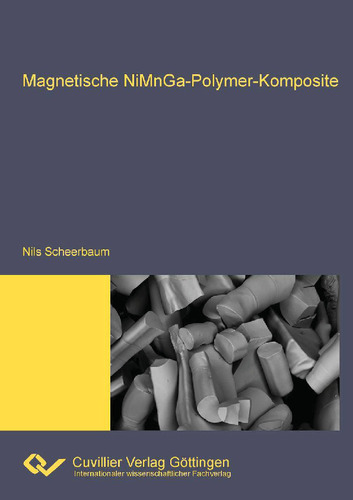
The annealed fibres break preferentially along the grain boundaries, which is why single- or oligocrystalline NiMnGa particles can be produced by relatively low mechanical loading of the fibres (mortaring or grinding between paper). Embedding these NiMnGa particles in a polymer matrix yields NiMnGa-polymer composites. The advantages of such composites are the relatively simple fabrication (crystallographically textured and in any desired shape), the reduction of eddy currents by the non-conducting matrix, and a potentially good fatigue behaviour, since the fracture of individual MSM particles does not lead to failure of the entire composite. Either polyester or polyurethane was used as the polymer matrix. The much softer polyurethane permits MIR in the embedded NiMnGa particles, whereby the polyurethane-NiMnGa composites are in principle suitable for actuator applications.
The magnetically induced strain (MFIS) in the composites is determined by the volume fraction of MSM material capable of MIR. In the composites used for the MFIS measurements this amounts to about (5-10)%, since only a part of the embedded NiMnGa particles is capable of MIR. The achievable MFIS in the composites investigated here can thus be estimated at a maximum of ~0.5% (for a polyurethane matrix) and ~0.1% (for a polyester matrix), respectively. For the polyurethane matrix composites a maximum, reproducible MFIS of (0.2-0.5)% is measured, which corresponds to the above MFIS estimate. Decisive here is above all the preceding texturing of the MSM particles by compression of the composite (perpendicular to the subsequent magnetic field direction). A preceding texturing by a magnetic field yields MFIS values only one order of magnitude smaller. Owing to the too rigid matrix, polyester matrix composites show no MFIS.
Both polyester and polyurethane matrix composites show a stress-induced twin boundary motion. This is demonstrated both by texture measurements with synchrotron radiation and by magnetic measurements on the composites. Through compression, the compression direction of the composite becomes easier to magnetise, because a (004) fibre texture (c-axis) develops in this direction. The degree of twin boundary motion increases with greater deformation and, for a given deformation, is greater for polyester matrix composites owing to the harder matrix. The investigated NiMnGa-polymer composites are thus suitable as mechanically and magnetically controllable dampers.
| ISBN-13 (Printausgabe) | 3869552115 |
| ISBN-13 (Hard Copy) | 9783869552118 |
| ISBN-13 (eBook) | 9783736932111 |
| Final Book Format | A5 |
| Language | German |
| Page Number | 78 |
| Edition | 1 Aufl. |
| Volume | 0 |
| Publication Place | Göttingen |
| Place of Dissertation | TU Dresden |
| Publication Date | 2010-01-07 |
| General Categorization | Dissertation |
| Departments |
Mechanical and process engineering
|


