
Cuvillier Verlag GmbH



| Departments | |
|---|---|
| Book Series (99) |
1418
|
| Nachhaltigkeit |
3
|
| Gesundheitswesen |
3
|
| Humanities |
2417
|
| Natural Sciences |
5433
|
| Engineering |
1825
|
| Engineering | 292 |
| Mechanical and process engineering | 875 |
| Electrical engineering | 701 |
| Mining and metallurgy | 30 |
| Architecture and civil engineering | 76 |
| Common |
97
|
|
Leitlinien Unfallchirurgie
5. Auflage bestellen |
|
Advanced Search
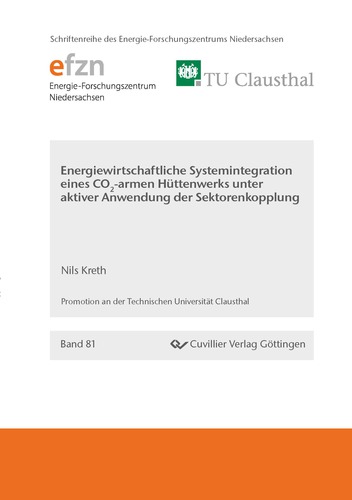
Energiewirtschaftliche Systemintegration eines CO2-armen Hüttenwerks unter aktiver Anwendung der Sektorenkopplung (Volume 81) (English shop)
Nils Kreth (Author)Preview
Extract, PDF (110 KB)
Table of Contents, PDF (48 KB)
This work examines the energy-related interdependencies of an integrated steelworks before, during and after its transformation into a low-CO2 steelworks. The objective is to minimise energy costs for natural gas, electrical energy and, in future, hydrogen. The optimisation model to be developed is intended to distribute the by-product gases in such a way that a high level of energy and cost efficiency is achieved. The energy demand to be covered is calculated on the basis of the specified production time series.
The data and process sequences for the modelling were provided by Salzgitter Flachstahl GmbH.
| ISBN-13 (Hard Copy) | 9783736979338 |
| ISBN-13 (eBook) | 9783736969339 |
| Final Book Format | A5 |
| Language | German |
| Page Number | 162 |
| Lamination of Cover | matt |
| Edition | 1. |
| Book Series | Schriftenreihe des Energie-Forschungszentrums Niedersachsen (EFZN) |
| Volume | 81 |
| Publication Place | Göttingen |
| Place of Dissertation | Clausthal |
| Publication Date | 2024-01-04 |
| General Categorization | Dissertation |
| Departments |
Energy engineering
|
| Keywords | Decarbonization of the steel industry, Hydrogen economy, Linear optimization model, Energy efficiency in industry, Sustainable steel production, Energetic process integration, CO2-neutral production pathways, Green energy systems, Flexibility in production, Renewable energies in industry, Hydrogen production through electrolysis, Integration of renewable sources, Climate-friendly steel manufacturing, Sector coupling in industry, Techno-economic analysis, Resource efficiency, Electrification of steel production, Cost optimization in the steel sector, Green steel, Reduction of greenhouse gas emissions, Industrial energy optimization, Climate protection in heavy industry, Hydrogen economy in the steelworks, Renewable energy sources, Optimization of energy systems, Innovation strategies in the steel industry, Low-CO2 steel production, Energy cost minimization, Transformation pathways of steel production, Industrial decarbonization technologies, Emission reduction in heavy industry, Future-oriented steelworks, Decarbonization of the steel industry, Hydrogen economy, Linear optimization model, Energy efficiency in industry, Sustainable steel production, Energetic process integration, CO2-neutral production pathways, Green energy systems, Flexibility in production, Renewable energies in industry, Hydrogen production through electrolysis, Integration of renewable sources, Climate-friendly steel manufacturing, Sector coupling in industry, Techno-economic analysis, Resource efficiency, Electrification of steel production, Cost optimization in the steel sector, Green steel, Reduction of greenhouse gas emissions, Industrial energy optimization, Climate protection in heavy industry, Hydrogen economy in the steelworks, Renewable energy sources, Optimization of energy systems, Innovation strategies in the steel industry, Low-CO2 steel production, Energy cost minimization, Transformation pathways of steel production, Industrial decarbonization technologies, Emission reduction in heavy industry, Future-oriented steelworks |


