
Cuvillier Verlag GmbH



| Departments | |
|---|---|
| Book Series (99) |
1415
|
| Nachhaltigkeit |
3
|
| Gesundheitswesen |
3
|
| Humanities |
2410
|
| Natural Sciences |
5428
|
| Engineering |
1820
|
| Engineering | 292 |
| Mechanical and process engineering | 872 |
| Electrical engineering | 699 |
| Mining and metallurgy | 30 |
| Architecture and civil engineering | 76 |
| Common |
97
|
|
Leitlinien Unfallchirurgie
5. Auflage bestellen |
|
Advanced Search
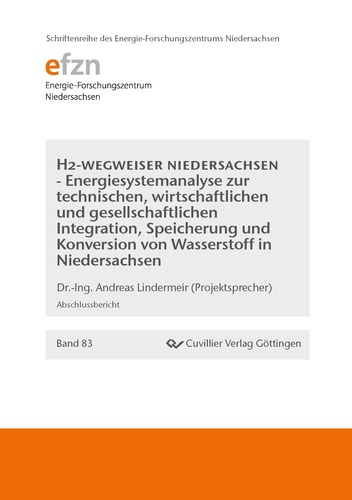
H2-Wegweiser Niedersachsen (Volume 83) (English shop)
Energiesystemanalyse zur technischen, wirtschaftlichen und gesellschaftlichen Integration, Speicherung und Konversion von Wasserstoff in Niedersachsen
Andreas Lindermeir (Author)Preview
Extract, PDF (1.2 MB)
Table of Contents, PDF (8.9 MB)
Hydrogen is a central building block for converting Germany’s energy supply and industry to climate-friendly and sustainable processes. Lower Saxony possesses a number of unique features that predestine it for a pioneering role in establishing a “green hydrogen economy” and that can be used to strengthen the regional economic system. These include high generation capacities for renewable electricity, geological characteristics that permit the underground storage of hydrogen, and the maritime infrastructure, which enables participation in global energy trade and thus also the import of hydrogen and its derivatives. In addition, with the steel and cement industries and the refineries located there, Lower Saxony is home to major CO2 emitters that are under considerable pressure to act and for which the use of green hydrogen represents an option for sustainable transformation.
The H2-Wegweiser project was carried out from May 2021 to August 2024 by a consortium of nine partners from TU Clausthal, LU Hannover and ISFH, and aimed to specify the role of Lower Saxony within a German “hydrogen economy” and thus to contribute to the ecologically and economically effective integration of green hydrogen and its derivatives into Lower Saxony’s future energy system. In order to do justice to the multi-layered nature and complexity of the associated questions, a coordinated and interdisciplinary approach was required that links technical, legal, economic, social and ecological aspects. To this end, the H2-Wegweiser project systematically analysed and evaluated the key technologies of the hydrogen value chain, such as hydrogen production, underground storage and conversion, with regard to the aforementioned aspects, using modelling approaches at various levels of detail.
This EFZN volume reports in detail on the approaches, methods and results of the project.
| ISBN-13 (Hard Copy) | 9783689529451 |
| ISBN-13 (eBook) | 9783689529468 |
| Final Book Format | A5 |
| Language | German |
| Page Number | 188 |
| Lamination of Cover | matt |
| Edition | 1 |
| Book Series | Schriftenreihe des Energie-Forschungszentrums Niedersachsen (EFZN) |
| Volume | 83 |
| Publication Place | Göttingen |
| Publication Date | 2024-11-04 |
| General Categorization | Non-Fiction |
| Departments |
Energy engineering
|
| Keywords | Energy, Lower Saxony, hydrogen production, hydrogen storage, hydrogen conversion, electricity, natural gas, water, renewable energies, Germany, production, methane, emissions, environment, energy, hydrogen production, hydrogen storage, hydrogen conversion, energy, natural gas, water, renewable energies, germany, production, methan, emissions, environment |


