
Cuvillier Verlag GmbH



| Departments | |
|---|---|
| Book Series (99) |
1423
|
| Nachhaltigkeit |
3
|
| Gesundheitswesen |
3
|
| Humanities |
2427
|
| Medienwissenschaften | 17 |
| Theology | 59 |
| Philosophy | 105 |
| Law | 434 |
| Economics | 868 |
| Social sciences | 425 |
| Sports science | 48 |
| Psychology | 233 |
| Educational science | 190 |
| History | 196 |
| Art | 111 |
| Cultural studies | 170 |
| Literary studies | 120 |
| Linguistics | 91 |
| Natural Sciences |
5436
|
| Engineering |
1827
|
| Common |
97
|
|
Leitlinien Unfallchirurgie
5. Auflage bestellen |
|
Advanced Search
Hard Copy
EUR 85.10
E-book
EUR 59.60
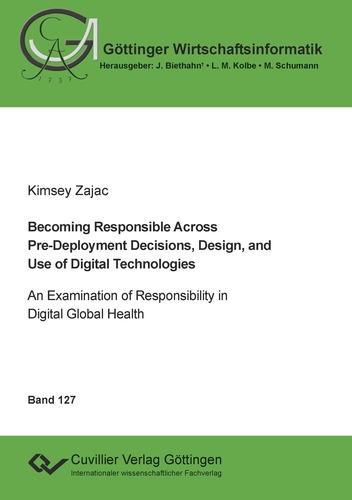
Becoming Responsible Across Pre-Deployment Decisions, Design, and Use of Digital Technologies (Volume 127) (English shop)
An Examination of Responsibility in Digital Global Health
Kimsey Zajac (Author) ORCID ISNIPreview
Extract, PDF (950 KB)
Table of Contents, PDF (710 KB)
The research presented in this dissertation builds on a simple premise: digital technolo-gies can generate substantial benefits but may also produce unintended consequences that can harm individuals, organizations, and society. As their outcomes increasingly emerge from complex interactions among humans, technologies, and contexts, it be-comes difficult to determine who can and should be responsible for anticipating, prevent-ing, and mitigating such consequences. Existing information systems research provides important normative and conceptual accounts of responsibility in socio-technical contexts as well as empirical insights on responsibility-related issues such as privacy, fairness, security, transparency, ethical design, and increasingly responsible artificial intelligence. Yet, it lacks a conceptually integrated and empirically informed account of how responsi-bility can be located and enacted across different phases of the digitalization process. Existing work predominantly specifies what actors ought to do and what properties re-sponsible systems should possess; considerably less research explains empirically who comes to bear responsibility for particular consequences, to whom they are answerable, how responsibility is divided across interdependent human and technological actors, how those allocations change from design through deployment and use, and how responsibil-ity is contested, displaced, or reassigned when outcomes materialize. This cumulative dissertation addresses this gap by examining how stakeholders can become responsible across pre-deployment decisions, design, and technology use.
To this end, the dissertation draws on five studies in digital global health, with a particular focus on low-resource contexts in sub-Saharan Africa. The studies employ geospatial mapping, computational text analysis, a systematic literature review, design science re-search, and qualitative analysis of healthcare workers’ technology-supported decision-making. Four of the five studies approach responsibility primarily from a normative and prospective perspective by examining concrete mechanisms through which actors can enact responsibility. Studies 1 and 2 show that responsibility must already be enacted before deployment, requiring supranational and governmental actors to anticipate where digital interventions are most needed and whose needs risk being overlooked. Studies 3 and 4 turn to responsible design, demonstrating that responsibility requires accounting for both directly and indirectly affected stakeholders and creating conditions that support responsible technology use while safeguarding against unintended consequences. Study 5, by contrast, examines responsibility as a socio-technical phenomenon that is consti-tuted through actors’ interpretations and positioning in relation to human and technologi-cal actors. It shows that, beyond normative prescriptions, responsibility is not simply fixed in advance but may be retained, shared, or displaced as users attribute agency and re-sponsibility to digital technologies, with consequences for subsequent behavior. Taken together, the studies demonstrate that becoming responsible requires attention to distinct but interrelated points in the digitalization process and that responsibility must be under-stood both as a normative requirement guiding what actors ought to do and as a socio-technical phenomenon whose attribution and enactment can themselves be empirically examined.
Synthesizing these findings with perspectives from philosophy, technology ethics, and information systems research, the dissertation develops a framework of continuous re-sponsibility alignment. The framework rests on a central distinction between bearing re-sponsibility and becoming responsible in practice. It differentiates responsibility for, in, and through digital systems across context, artifact, and use layers and specifies the con-ditions under which attributed responsibility can be meaningfully enacted. First, respon-sibility must be located with actors who possess sufficient agency to discharge the corre-sponding obligations (responsibility–agency alignment). Second, those actors must rec-ognize and retain their responsibility and translate it into corresponding decisions and actions (responsibility–action alignment). Because technologies, agency conditions, re-sponsibility configurations, and practices may change over time, both forms of alignment require repeated reassessment. The dissertation thereby contributes a theory-informed and empirically illustrated account of responsibility as a dynamic socio-technical process and provides a diagnostic framework for identifying when responsibility can be meaning-fully enacted and where responsibility gaps may emerge.
| ISBN-13 (Hard Copy) | 9783689526450 |
| ISBN-13 (eBook) | 9783689526467 |
| Final Book Format | A5 |
| Language | Englisch |
| Page Number | 280 |
| Lamination of Cover | glossy |
| Edition | 1. |
| Book Series | Göttinger Wirtschaftsinformatik |
| Volume | 127 |
| Publication Place | Göttingen |
| Publication Date | 2026-11-09 |
| General Categorization | Dissertation |
| Departments |
Wirtschaftswissenschaften
Informatik |
| Keywords | Responsible Digitalization, Information Systems, Digital Global Health, Information and Communication Technologies for Development, digitale globale Gesundheitsversorgung, Digitale Verantwortung, Technologieethik, Health Informatics, Gesundheitsinformatik, Mensch-Technologie-Interaktion, Human-Technology Interaction |


