
Cuvillier Verlag GmbH



| Departments | |
|---|---|
| Book Series (99) |
1415
|
| Nachhaltigkeit |
3
|
| Gesundheitswesen |
3
|
| Humanities |
2412
|
| Natural Sciences |
5430
|
| Engineering |
1821
|
| Engineering | 292 |
| Mechanical and process engineering | 872 |
| Electrical engineering | 700 |
| Mining and metallurgy | 30 |
| Architecture and civil engineering | 76 |
| Common |
97
|
|
Leitlinien Unfallchirurgie
5. Auflage bestellen |
|
Advanced Search
Elektromagnetische Verträglichkeit und Signalintegrität hochbitratiger Datenbussysteme im Kraftfahrzeug (English shop)
Volker Zwillich (Author)Preview
Table of Contents, Datei (36 KB)
Extract, Datei (66 KB)
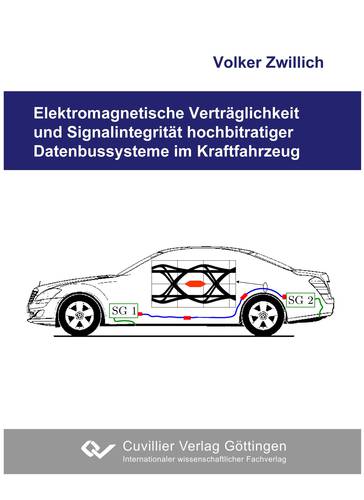
This work addresses high-bit-rate baseband data transmission over copper cables in passenger cars with respect to EMC and signal integrity.
Future applications require data rates in the Gbit/s range that can no longer be transmitted over conventional cables. Starting from conventional unshielded UTP cables, unshielded as well as shielded flat cables and finally shielded star-quad cables were investigated with regard to their suitability as data transmission cables in passenger cars. Different communication hardware was employed according to the targeted data rate. The aim was to establish the range of application (max. data rate, cable length) of different cable types. First, the limits of low-cost transmission lines were demonstrated empirically and by simulation, and their use for the Gbit/s range was investigated.
The analysis of data transmission over the low-cost UTP cable revealed that disastrous data losses and, as a consequence, system breakdowns can occur when transmitting data above approx. 100 Mbit/s. The reason for the data losses are impedance fluctuations, which occur when the distance between the cable and ground changes and which can lead to critical resonances, particularly in the case of a periodic impedance profile. The measurement of the data losses could be confirmed very well in the simulation.
The resonance effects were also observed in the unshielded flat cable, which is used because of its low-cost installation and its space advantages in flat installation spaces. In addition, there is the possibility of extremely large crosstalk when flat cables are routed closely one above the other in confined installation spaces. Furthermore, an asymmetrical distance to the body ground gives rise to common-mode interference, which leads to high electromagnetic emission.
As a solution to these problems, this work extended flat cable technology by impedance-controlled shielded flat cables. Novel shielded flat cables were designed, manufactured, characterised and optimised. It was shown that the resonance, crosstalk and emission problems are eliminated. The shielded flat cables are particularly well suited for flat installation spaces with straight routing paths and can be used up to approx. 1 Gbit/s.
The star-quad cable has proven to be the standard cable for high data rates with good bending properties. The favourable star-quad configuration with an orthogonal conductor arrangement is – also from an EMC point of view, owing to the low coupling – very well suited for high data rates, which was verified empirically up to the Gbit/s range. The limitation of the data rate is almost exclusively attributable to the cable attenuation.
In order to describe the cable attenuation and thus the transmission limits, an analytical transmission line model for the star-quad cable was, for the first time, extended and adapted in this work such that it delivers very accurate and causal results. Physical descriptions of the dielectric losses were selected and approximations for the transition from direct current to the high-frequency range were determined. Applied in a simulation setup of an arbitrary transmission link, this model allows the maximum cable length to be obtained quickly as a function of the data rate, permitting predictions about the transmission reliability of future systems. Because of its high data rate, good EMC properties and low power consumption, the LVDS transmission link is very well suited for use in passenger cars and was employed to verify the transmission line model. It was demonstrated that at a data rate of 1.5 Gbit/s cable lengths of 8 m and 15 m respectively (with additional pre-emphasis) are possible, which enables use in the vehicle. The accuracy and efficiency of the simulation could be improved considerably by first simulating in the frequency domain and subsequently transforming back to time-domain signals.
After studying electrical engineering at RWTH Aachen (2001), Volker Zwillich initially worked at Daimler AG in Ulm on the electromagnetic compatibility (EMC) of data bus systems. From 2003 to 2008 he completed his doctorate at the University of Ulm, Institute of Microwave Techniques, in the field of EMC and signal integrity of high-bit-rate data bus systems in motor vehicles. Since 2008 Volker Zwillich has been working at BMW AG on the EMC of the complete vehicle.
| ISBN-13 (Printausgabe) | 3869550945 |
| ISBN-13 (Hard Copy) | 9783869550947 |
| ISBN-13 (eBook) | 9783736930940 |
| Final Book Format | A5 |
| Language | German |
| Page Number | 126 |
| Lamination of Cover | glossy |
| Edition | 1 Aufl. |
| Volume | 0 |
| Publication Place | Göttingen |
| Place of Dissertation | Universität Ulm |
| Publication Date | 2009-08-28 |
| General Categorization | Dissertation |
| Departments |
Electrical engineering
|


