
Cuvillier Verlag GmbH



| Departments | |
|---|---|
| Book Series (99) |
1415
|
| Nachhaltigkeit |
3
|
| Gesundheitswesen |
3
|
| Humanities |
2412
|
| Natural Sciences |
5430
|
| Engineering |
1821
|
| Engineering | 292 |
| Mechanical and process engineering | 872 |
| Electrical engineering | 700 |
| Mining and metallurgy | 30 |
| Architecture and civil engineering | 76 |
| Common |
97
|
|
Leitlinien Unfallchirurgie
5. Auflage bestellen |
|
Advanced Search
Kompakter rückspeisefähiger Antriebsstromrichter mit SiC-JFETs und sinusförmigen Ausgangsspannungen (English shop)
Alvaro Orellana (Author)Preview
Table of Contents, Datei (36 KB)
Extract, Datei (94 KB)
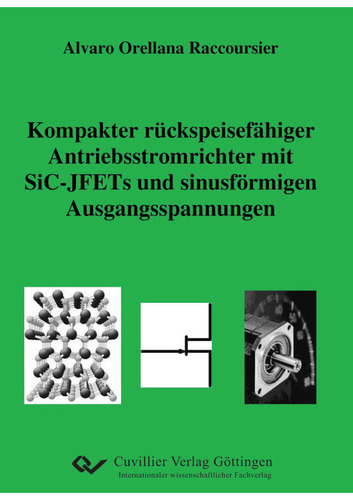
This thesis presents a practical investigation of the use of silicon carbide (SiC) power semiconductors in electrical drive technology. The physical properties of this semiconductor material are outstanding for power electronics, e.g. lower on-state resistance at higher blocking voltage and higher temperature stability than silicon.
Available SiC power switches of the JFET type are analysed. Subsequently, a new converter using these devices is designed, built, tested and investigated.
The aim is to develop a new compact regenerative drive converter that provides sinusoidal voltages at the motor terminals. In contrast to pulsed voltages, sinusoidal voltages increase the service life of the motor. In a conventional IGBT converter, the filters for the pulsed inverter voltages are very large, heavy and therefore very expensive. The low-switching-loss SiC inverter developed here, by contrast, can be operated at high switching frequencies (e.g. 125 kHz), which results in a considerably smaller volume, a lower weight and thus a reduction in the cost of the filters.
This is to be achieved while complying with the relevant standards for electromagnetic compatibility (EMC).
The work is structured as follows:
Chapter 2 explains the problems associated with the pulsed output voltages of a drive converter and presents a solution.
Chapter 3 presents and examines both the physical properties of silicon carbide and various power semiconductor devices.
Chapter 4 is devoted to a thorough analysis of the silicon carbide junction field effect transistor (SiC-JFET) used in the realised converter. The gate drive circuit developed and the design of a drive converter are also described here.
Chapter 5 explains the topology and the construction of the regenerative PWM converter employed, with an active rectifier switched at line frequency.
Chapter 6 describes the line-side and motor-side filters of the converter in detail, from the determination of the filter characteristics for the differential- and common-mode systems, through the design of the filters, to the construction of the inductive components.
In addition to the measurements already presented, Chapter 7 presents the most important results, including the EMC measurements.
| ISBN-13 (Printausgabe) | 3869550074 |
| ISBN-13 (Hard Copy) | 9783869550077 |
| ISBN-13 (eBook) | 9783736930070 |
| Final Book Format | A5 |
| Language | German |
| Page Number | 246 |
| Lamination of Cover | glossy |
| Edition | 1 Aufl. |
| Volume | 0 |
| Publication Place | Göttingen |
| Place of Dissertation | Universität Erlangen |
| Publication Date | 2009-06-08 |
| General Categorization | Dissertation |
| Departments |
Electrical engineering
|


