
Cuvillier Verlag GmbH



| Departments | |
|---|---|
| Book Series (99) |
1415
|
| Nachhaltigkeit |
3
|
| Gesundheitswesen |
3
|
| Humanities |
2411
|
| Natural Sciences |
5429
|
| Mathematics | 230 |
| Informatics | 320 |
| Physics | 982 |
| Chemistry | 1371 |
| Geosciences | 131 |
| Human medicine | 246 |
| Stomatology | 10 |
| Veterinary medicine | 112 |
| Pharmacy | 147 |
| Biology | 837 |
| Biochemistry, molecular biology, gene technology | 121 |
| Biophysics | 25 |
| Domestic and nutritional science | 45 |
| Agricultural science | 1005 |
| Forest science | 201 |
| Horticultural science | 20 |
| Environmental research, ecology and landscape conservation | 148 |
| Engineering |
1821
|
| Common |
97
|
|
Leitlinien Unfallchirurgie
5. Auflage bestellen |
|
Advanced Search
Gleichgewichtsmechanik und Flutuation von Superhelices (English shop)
Thomas Bornschlögl (Author)Preview
Table of Contents, Datei (32 KB)
Extract, Datei (230 KB)
Proteins are among the basic building blocks of the cell; they lend it stability and act as nanomachines involved in all cellular processes. They consist of a linear sequence of amino acids, with 20 different amino acids, each with specific physical properties, being used. Proteins can only perform their function in their correctly folded, three-dimensional tertiary or quaternary structure. For a large number of proteins, this folding occurs spontaneously and without further helper proteins in a physiological environment. The resulting structure of the protein then depends solely on the sequential arrangement of the amino acids within the chain. The folding process is extremely complex, and a prediction of the folded structure from the amino acid sequence alone is possible only in special cases or by comparative methods.
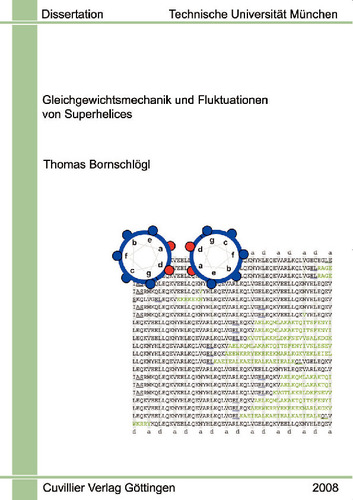
A structure frequently found in proteins is the superhelix (or “coiled coil”), which is characterised by its very simple architecture. Superhelices consist of at least two α-helices that wind around each other. Despite this simple structure, the intra- and intermolecular interactions of the individual α-helices are highly complex. This makes the superhelix a much-studied model system, on the basis of which attempts are made to clarify general questions of protein folding.
Because of their special mechanical properties, superhelices are also frequently found at sites exposed to the action of forces. Examples are the group of intermediate filaments, which are, among other things, a component of the cytoskeleton or occur as keratin in hair, horn and feathers, as well as fibrinogen, which plays a role in blood coagulation. Superhelices can also actively exert force during their folding. This is physiologically relevant, for example, in membrane fusion as it occurs in viruses (HIV gp41 complex) or transport vesicles (SNARE complex). A further example are molecular motors, which play an important role in all cellular processes that require movement. Molecular motors frequently occur as oligomers, with oligomerisation mostly achieved by superhelices. These are exposed to lateral forces when the motor moves.
In this work, the mechanical method of atomic force microscopy (AFM) is applied in order to separate dimeric superhelices step by step. By means of a laterally acting force applied at one end of a single superhelical molecule, the two α-helices can be separated from one another. It is shown that the resolving power of the method is sufficient to detect the effects of individual amino acid substitutions. Since both the thermodynamic equilibrium and the non-equilibrium regime are experimentally accessible in superhelix folding, the applicability of Crooks’ fluctuation theorem to measurements with the atomic force microscope (AFM) could be demonstrated for the first time. In addition, the mechanical properties of various superhelices occurring in molecular motors are investigated.
| ISBN-13 (Printausgabe) | 3867278148 |
| ISBN-13 (Hard Copy) | 9783867278140 |
| ISBN-13 (eBook) | 9783736928145 |
| Language | German |
| Page Number | 146 |
| Edition | 1 Aufl. |
| Volume | 0 |
| Publication Place | Göttingen |
| Place of Dissertation | TH München |
| Publication Date | 2008-12-03 |
| General Categorization | Dissertation |
| Departments |
Physics
Biology |


