
Cuvillier Verlag GmbH



| Departments | |
|---|---|
| Book Series (99) |
1415
|
| Nachhaltigkeit |
3
|
| Gesundheitswesen |
3
|
| Humanities |
2411
|
| Natural Sciences |
5430
|
| Mathematics | 230 |
| Informatics | 320 |
| Physics | 982 |
| Chemistry | 1371 |
| Geosciences | 131 |
| Human medicine | 246 |
| Stomatology | 10 |
| Veterinary medicine | 112 |
| Pharmacy | 147 |
| Biology | 837 |
| Biochemistry, molecular biology, gene technology | 121 |
| Biophysics | 25 |
| Domestic and nutritional science | 45 |
| Agricultural science | 1006 |
| Forest science | 201 |
| Horticultural science | 20 |
| Environmental research, ecology and landscape conservation | 149 |
| Engineering |
1821
|
| Common |
97
|
|
Leitlinien Unfallchirurgie
5. Auflage bestellen |
|
Advanced Search
Struktur, Stabilität und Funktionalisierung metalloider Aluminiumcluster (English shop)
Michael Huber (Author)Preview
Table of Contents, Datei (62 KB)
Extract, Datei (170 KB)
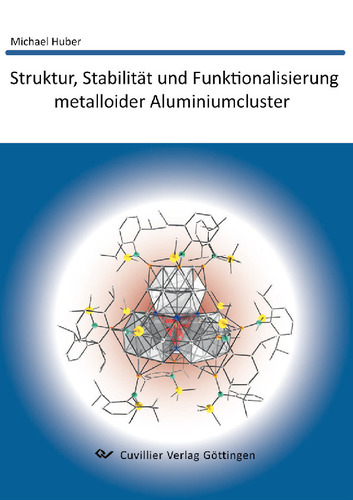
This work is essentially concerned with the structure and stability of metalloid cluster compounds of aluminium as a function of the stabilising ligand systems. The designation “metalloid” emphasises that these cluster compounds exhibit, within their framework of metal atoms, topologies similar to those of the metallic solid. In the field of cyclopentadienyl derivatives, it was possible to explain the preferred formation and the particular stability with respect to disproportionation of metalloid cluster systems of aluminium bearing pentamethylcyclopentadienyl (Cp*) as the stabilising substituent, in comparison with the less sterically demanding tetramethylcyclopentadienyl (Cp4Me) and cyclopentadienyl (Cp).
Particular attention was paid to investigations of the equilibrium present between monomeric AlR and tetrameric Al4R4 (R = Cp, Cp4Me, Cp*) and of the tendency of these species to disproportionate into solid aluminium metal and AlR3.
On the basis of these investigations it was also possible to explain the special position occupied by Al4Cp*4 with regard to its preparation by the classical route, to disproportionation and to reactivity in comparison with Al4(Cp4Me)4 and Al4Cp4.
With a different ligand system, the synthesis of two metalloid aluminium clusters, Si@Al56[N(Dipp)SiMe3]12 and Si@Al14[N(Dipp)SiMe3]6 (Dipp = 2,6-iPr2C6H3), which contain a silicon atom as the central atom, was achieved. The incorporation of a heteroatom into the cluster brings about a drastic change in the topology within the metal framework in comparison with other, already known metalloid cluster systems. This leads to structural motifs that are considerably more similar to alloys of aluminium than to the pure metal itself. Consequently, there is also the possibility of further functionalising such metalloid cluster compounds by incorporating other heteroatoms, such as transition metals, in place of silicon, and in this way perhaps of arriving at unusual magnetic properties of these systems.
The metalloid aluminium cluster compounds presented in this work impressively demonstrate a link between molecular and solid-state chemistry. The connecting element is precisely these metalloid cluster compounds which, starting from metastable molecular compounds – for example in the disproportionation of AlI halides – represent snapshots along the path of the formation of the metal and which, consistently, approach the structure of the metals with regard to the topology of the metal atoms.
| ISBN-13 (Printausgabe) | 3867277974 |
| ISBN-13 (Hard Copy) | 9783867277976 |
| ISBN-13 (eBook) | 9783736927971 |
| Language | German |
| Page Number | 152 |
| Edition | 1 Aufl. |
| Volume | 0 |
| Publication Place | Göttingen |
| Place of Dissertation | TH Karlsruhe |
| Publication Date | 2008-11-19 |
| General Categorization | Dissertation |
| Departments |
Chemistry
|


