
Cuvillier Verlag GmbH



| Departments | |
|---|---|
| Book Series (99) |
1418
|
| Nachhaltigkeit |
3
|
| Gesundheitswesen |
3
|
| Humanities |
2418
|
| Medienwissenschaften | 17 |
| Theology | 57 |
| Philosophy | 103 |
| Law | 432 |
| Economics | 867 |
| Social sciences | 423 |
| Sports science | 48 |
| Psychology | 233 |
| Educational science | 190 |
| History | 194 |
| Art | 111 |
| Cultural studies | 168 |
| Literary studies | 119 |
| Linguistics | 91 |
| Natural Sciences |
5433
|
| Engineering |
1825
|
| Common |
97
|
|
Leitlinien Unfallchirurgie
5. Auflage bestellen |
|
Advanced Search
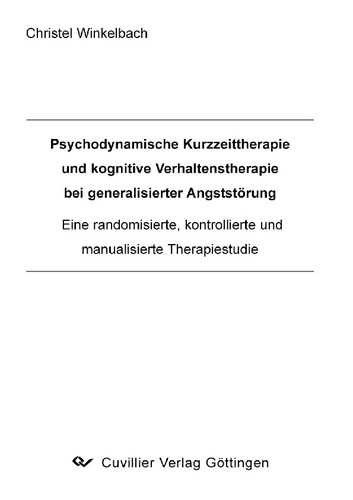
"Psychodynamische Kurzzeittherapie und kognitive Verhaltenstherapie bei generalisierter Angststörung – eine randomisierte, kontrollierte und manualisierte Therapiestudie." (English shop)
Christel Winkelbach (Author)Preview
Table of Contents, Datei (53 KB)
Extract, Datei (42 KB)
Generalized anxiety disorder (GAD) is a common, chronic disorder that causes severe psychosocial impairment (Wittchen & Hoyer, 2001). From 2001 to 2007, the effectiveness and stability of therapeutic interventions were examined in a controlled, randomized psychotherapy study involving 59 patients with GAD. The two forms of therapy (cognitive-behavioral therapy, CBT, and supportive-expressive therapy, SET) were examined with regard to their efficacy on various parameters (anxiety, worrying, comorbid depressiveness, interpersonal problems, health-related satisfaction) and compared with one another. The diagnostic assessments and the monitoring were carried out mainly by the author of this work in her capacity as a research associate at the Department of Psychotherapy and Psychosomatics of the University of Göttingen. The psychotherapeutic treatments took place in the practices of 9 therapists in private practice from Göttingen and the surrounding area. The therapies were manualized and comprised 25 sessions, once a week for 50 minutes. The CBT manual was based on the treatment manual of the research group around Barlow (Brown, O’Leary & Barlow, 1993) and consists of psychoeducation (disorder, anxiety, worry mechanism) and the learning of relaxation techniques, the modification of dysfunctional thoughts, and worry exposure. The SET manual represents a modified version of SET according to Luborsky (1995), in which the emphasis lies on discovering and working through the core conflictual relationship theme using supportive and expressive techniques.
The two psychotherapeutic procedures examined, in particular the cognitive-behavioral treatment, proved to be highly effective in patients with generalized anxiety disorder and stable in their effects over a follow-up period of six months. The high effect sizes found were evident in all symptom categories. Contrary to previous results from meta-analyses (Ruhmland & Margraf, 2001), short-term psychodynamic therapy also proved stable in its efficacy over the follow-up period. However, a comparable efficacy of the two forms of therapy could not be demonstrated in all symptom categories in this study. Although no statistically significant difference between the group results was found in most categories, the results of CBT tended to be better. A significant superiority of CBT was found mainly in the reduction of worrying. Beyond this, a generalizing conclusion regarding the superiority of one form of therapy cannot be drawn on account of the inconsistent findings and the small sample size. The results on clinical significance confirm previous findings. Despite the large improvement effects that were achieved, the percentages of ‘cured’ patients fall short of expectations. Therapy evaluation in cooperation with psychotherapists in private practice proved successful in this study. It was possible to combine some advantages of a naturalistic setting (long-practicing, scientifically independent clinicians) with the necessary requirements of a scientific study.
| ISBN-13 (Printausgabe) | 3867275750 |
| ISBN-13 (Hard Copy) | 9783867275750 |
| ISBN-13 (eBook) | 9783736925755 |
| Final Book Format | A5 |
| Language | German |
| Page Number | 142 |
| Edition | 1 Aufl. |
| Volume | 0 |
| Publication Place | Göttingen |
| Place of Dissertation | Universität Göttingen |
| Publication Date | 2008-10-10 |
| General Categorization | Dissertation |
| Departments |
Psychology
|
| Keywords | Psychotherapy, Anxiety |


