
Cuvillier Verlag GmbH



| Departments | |
|---|---|
| Book Series (99) |
1415
|
| Nachhaltigkeit |
3
|
| Gesundheitswesen |
3
|
| Humanities |
2412
|
| Natural Sciences |
5430
|
| Mathematics | 230 |
| Informatics | 320 |
| Physics | 982 |
| Chemistry | 1371 |
| Geosciences | 131 |
| Human medicine | 246 |
| Stomatology | 10 |
| Veterinary medicine | 112 |
| Pharmacy | 147 |
| Biology | 837 |
| Biochemistry, molecular biology, gene technology | 121 |
| Biophysics | 25 |
| Domestic and nutritional science | 45 |
| Agricultural science | 1006 |
| Forest science | 201 |
| Horticultural science | 20 |
| Environmental research, ecology and landscape conservation | 149 |
| Engineering |
1821
|
| Common |
97
|
|
Leitlinien Unfallchirurgie
5. Auflage bestellen |
|
Advanced Search
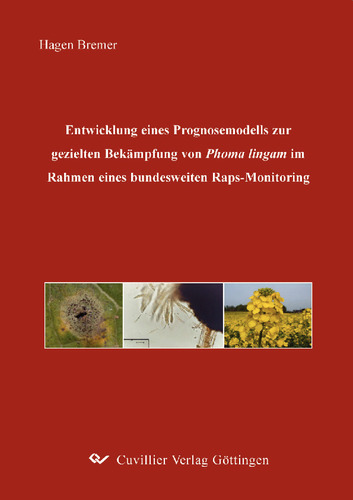
Entwicklung eines Prognosemodells zur gezielten Bekämpfung von Phoma lingam im Rahmen eines bundesweiten Raps-Monitoring (English shop)
Hagen Bremer (Author)Preview
Table of Contents, Datei (14 KB)
Extract, Datei (240 KB)
The most significant fungal pathogen in oilseed rape is Leptosphaeria maculans (Desm.) Ces. et de Not.; (anamorph: Phoma lingam (Tode ex Fr.) Desm.), the causal agent of blackleg (crown and stem rot). A nationwide monitoring of disease occurrence conducted in four oilseed rape growing regions and two cultivars served to develop a forecasting model for targeted autumn application in years with high disease pressure.
Studies on the epidemic development of Leptosphaeria maculans / Phoma lingam characterise site- and year-specific relationships between the pathogen and the environment. The parameters recorded were the within-crop weather conditions, pseudothecium development, ascospore release, and the course of pathogen infection on leaves, root collar and stem.
The investigations carried out demonstrate a relationship between pseudothecium development and ascospore release. Across all sites, ascospore occurrence was observed to differ in a year- and site-specific manner. The precipitation-influenced ascospore release was demonstrably related to autumn leaf infection.
Significant weather-, year- and site-specific relationships to the extent of autumn leaf infection could be demonstrated. The confirmed relationship between autumn leaf infection and root collar infection in the following year depends significantly on the temperature course during the decisive infection phase (September/October) and on the subsequent temperature course up to the start of the growing season. Significant site and year effects occurred in the yields determined; a cultivar effect was absent. A significant influence of the pathogen on yield could be demonstrated for the year 2007. Owing to the high yield losses caused by the pathogen in connection with autumn leaf and root collar infection, it is necessary to assess the infection risk in autumn and, where required, to take targeted fungicide measures.
The forecasting system developed from the available data is divided into different components. The development of a weather-based model for the daily infection probability was based on the daily infection value (TIW) and the epidemiological threshold values determined (disease parameter: disease incidence in the crop = BHB = percentage of infected plants in the crop). The cumulative daily infection value (k-TIW) derived from the TIW serves as an application recommendation once the defined thresholds “first appearance of visible symptoms” (ESS) and “disease incidence >50 %” (BHB50) have been exceeded. This system was supplemented by the visualisation of the individual infection events.
The differentiated fungicide applications carried out in the trials with the azole active ingredient metconazole resulted in a reducing effect on disease severity in autumn, which was reflected in the root collar area in spring. In autumn it became apparent that the early applications in particular allowed a recovery with renewed build-up of the pathogen population. Likewise, a lower reduction potential was observed with the delayed treatments in late autumn. The root collar assessments generally showed only minor differences between the differentiated autumn application treatments with regard to disease reduction.
Yield effects of the fungicide applications were mostly positive, but not always significant compared with the untreated control.
| ISBN-13 (Printausgabe) | 3867276250 |
| ISBN-13 (Hard Copy) | 9783867276252 |
| ISBN-13 (eBook) | 9783736926257 |
| Final Book Format | A5 |
| Language | German |
| Page Number | 212 |
| Edition | 1 Aufl. |
| Volume | 0 |
| Publication Place | Göttingen |
| Place of Dissertation | Kiel |
| Publication Date | 2008-06-17 |
| General Categorization | Dissertation |
| Departments |
Domestic and nutritional science
Agricultural science |
| Keywords | Leptosphaeria maculans, Phoma lingam, Phoma autumn forecast, ascospore flight ascospores, pycnidiospores, root collar and stem rot, autumn leaf infestation, stem infestation, root collar infestation, Phoma lingam infestation progression, Phoma lingam autumn infestation, oilseed rape pathogen, epidemiology, oilseed rape monitoring, control, leaf lesions, pseudothecia, crop residues, pseudothecia maturity, ascospore dispersal, Phoma leaf infection, canker, triazole, metconazole, autumn application, pycnidia, leaf necroses, crop residues, root collar lesion, Verticillium longisporum, Sclerotinia sclerotiorum, ascospore occurrence, pseudothecia development, pseudothecia maturity, pathotypes, Peronospora parasitica, Botrytis cinerea, fungicide application, flowering treatment, disease severity, disease incidence, autumn infection, primary infection, daily infection value, cumulative daily infection value, primary infestation, infection risk, infection probability, forecast, threshold values, Talent, Pronto, cultivar effects, TIE, k-TIW, leaf wetness, leaf moisture. |


