
Cuvillier Verlag GmbH



| Departments | |
|---|---|
| Book Series (99) |
1418
|
| Nachhaltigkeit |
3
|
| Gesundheitswesen |
3
|
| Humanities |
2418
|
| Natural Sciences |
5433
|
| Mathematics | 230 |
| Informatics | 321 |
| Physics | 982 |
| Chemistry | 1371 |
| Geosciences | 131 |
| Human medicine | 247 |
| Stomatology | 10 |
| Veterinary medicine | 112 |
| Pharmacy | 147 |
| Biology | 838 |
| Biochemistry, molecular biology, gene technology | 121 |
| Biophysics | 25 |
| Domestic and nutritional science | 45 |
| Agricultural science | 1006 |
| Forest science | 201 |
| Horticultural science | 20 |
| Environmental research, ecology and landscape conservation | 149 |
| Engineering |
1825
|
| Common |
97
|
|
Leitlinien Unfallchirurgie
5. Auflage bestellen |
|
Advanced Search
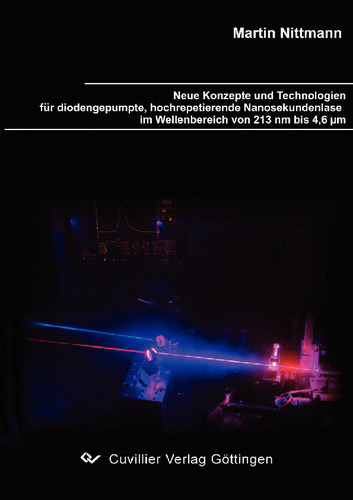
Neue Konzepte und Technologien für diodengepumpte, hochrepetierende Nanosekundenlaser im Wellenlängenbereich von 213 nm bis 4,6 μm (English shop)
Martin Nittmann (Author)Preview
Table of Contents, Datei (46 KB)
Extract, Datei (110 KB)
The basis is provided by diode-pumped solid-state lasers whose emission wavelengths of 1064 and 1342 nm are converted into other spectral ranges by means of a wide variety of nonlinear-optical techniques. The motivation arises from applications whose specific requirements cannot be met by previously available lasers. A large number of technological aspects that play a decisive role in application, such as a compact design or high long-term stability, are taken into account from the outset during the development of the systems.
The concept of the lasers is based on the use of fiber-coupled high-brightness diode laser modules, which are employed very efficiently in a longitudinal pumping geometry for the optical excitation of neodymium-doped yttrium vanadate (Nd:YVO4). Based on the standard laser transition at 1064 nm, an actively Q-switched laser with an average output power of 4.6 W and pulse durations of 8.9 ns at a pulse repetition rate of 15 kHz is realized. The emitted radiation is diffraction-limited with an M2 of less than 1.1. For optional power scaling, this laser is post-amplified in a single-pass amplifier stage to an average output power of 13 W.
The use of the 1342 nm laser transition in Nd:YVO4 opens up completely new possibilities for reaching particular spectral ranges by means of nonlinear optics. A laser optimized for this purpose achieves, using one pump diode, an average output power of 2.1 W with pulse durations of 9.2 ns at a pulse repetition rate of 10 kHz. To increase the power, the resonator concept is modified and a laser oscillator with two pump diodes is realized. At 15 kHz, it achieves an average power of 4.9 W with a pulse duration of 11 ns. The lasers developed are distinguished by their high efficiency, a compact design and very short pulse durations. Owing to the associated high peak powers in combination with excellent beam quality, suitability for optically nonlinear processes is ensured.
Building on these lasers, various concepts are investigated in order to convert the laser radiation into other spectral ranges by means of nonlinear optics.
The generation of the fifth harmonic of 1064 nm yields laser radiation in the deep ultraviolet at 213 nm. For the first time, a compact, long-term stable laser system with an average output power of up to 154 mW was realized via sum-frequency mixing of the second and third harmonics. During frequency conversion the pulse duration shortens to 5.3 ns at a pulse repetition rate of 15 kHz. Also outstanding here is the nearly preserved beam quality of the emitted radiation with an M2 of 1.4.
For the efficient generation of laser radiation in the red and blue spectral range, the harmonics of 1342 nm are used. The average output power achieved at 671 nm is 1.8 W with a pulse duration of 8 ns. In the blue spectral range, at 447 nm, the output power achieved is 1.4 W with a pulse duration of 12 ns. The combination of high output power, excellent beam quality and short pulse duration is unique to date.
Medical applications in the fields of dermatology and ophthalmology in particular require novel lasers in the yellow spectral range. Two completely different concepts are investigated for this purpose. The first approach to generating laser radiation in the yellow spectral range is a frequency-doubled self-Raman laser. Exploiting stimulated Raman scattering in YVO4, an average output power of 1.5 W is generated at a near-infrared wavelength of 1176 nm.
The second approach promises higher achievable output powers in the yellow spectral range. It uses sum-frequency mixing (SFG) of two synchronized laser oscillators at 1064 nm and 1342 nm. By phase-locked coupling of the AOM trigger to the RF wave, the temporal jitter of the respective nanosecond pulses relative to one another is reduced to about 500 ps. Comparative SFG experiments are carried out in the optically nonlinear materials LBO and BiBO. The highest average power at 593 nm, 1.6 W, is achieved in LBO and thus already meets the requirements of many applications. Moreover, these investigations demonstrate the potential of this concept and can be regarded as a basis for a large number of other experiments.
For the generation of high-power laser radiation in the mid-infrared, an optical parametric generator based on periodically poled MgO:LiNbO3 is pumped with the oscillator-amplifier system at 1064 nm. The system is continuously tunable over the entire frequency range from 3.5 to 4.6 μm and achieves average output powers of up to 700 mW at 3.7 μm and still 170 mW at 4.6 μm. The absolute wavelength accuracy of the automated tuning developed is better than 0.05 % of the wavelength without the use of a spectrometer.
In the final chapter it is shown that the laser at 1342 nm is likewise ideally suited for efficiently pumping an optical parametric generator (OPG). With this concept, the degeneracy range of systems pumped at 1064 nm can be extended around 2 μm. Analogously, an OPG pumped at 671 nm is realized, generating tunable radiation in the range of 1100 nm. Both concepts are unique to date and have not been published in the literature.
| ISBN-13 (Printausgabe) | 3867276056 |
| ISBN-13 (Hard Copy) | 9783867276054 |
| ISBN-13 (eBook) | 9783736926059 |
| Language | German |
| Page Number | 174 |
| Edition | 1 |
| Volume | 0 |
| Publication Place | Göttingen |
| Place of Dissertation | Kaiserslautern |
| Publication Date | 2008-05-28 |
| General Categorization | Dissertation |
| Departments |
Physics
|
| Keywords | Laser, Nd:YVO4, Q-switching, DPSSL, short-pulse laser, nanosecond laser, nonlinear optics, optical parametric processes, tunable light sources, Raman laser, UV laser (ultraviolet laser), IR laser (infrared laser). |


