
Cuvillier Verlag GmbH



| Departments | |
|---|---|
| Book Series (99) |
1415
|
| Nachhaltigkeit |
3
|
| Gesundheitswesen |
3
|
| Humanities |
2411
|
| Natural Sciences |
5430
|
| Mathematics | 230 |
| Informatics | 320 |
| Physics | 982 |
| Chemistry | 1371 |
| Geosciences | 131 |
| Human medicine | 246 |
| Stomatology | 10 |
| Veterinary medicine | 112 |
| Pharmacy | 147 |
| Biology | 837 |
| Biochemistry, molecular biology, gene technology | 121 |
| Biophysics | 25 |
| Domestic and nutritional science | 45 |
| Agricultural science | 1006 |
| Forest science | 201 |
| Horticultural science | 20 |
| Environmental research, ecology and landscape conservation | 149 |
| Engineering |
1821
|
| Common |
97
|
|
Leitlinien Unfallchirurgie
5. Auflage bestellen |
|
Advanced Search
Einblicke in den Mechanismus der mitochondriellen Sulfidoxidation bei Tieren (English shop)
Tatjana Hildebrandt (Author)Preview
Table of Contents, Datei (52 KB)
Extract, Datei (170 KB)
Sulfide was initially known as a poison before its role as an energy source for marine invertebrates was discovered, and finally, a few years ago, it turned out that H2S can also serve as a signalling molecule. The present work deals with the mechanism of mitochondrial sulfide oxidation in the sulfide-adapted invertebrate Arenicola marina and in the rat as an example of a mammal.
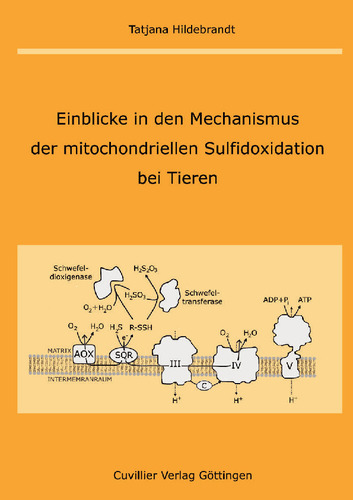
A reaction sequence of three enzymatic steps was identified which, in the mitochondria of the lugworm as well as in rat liver mitochondria, converts sulfide to thiosulfate. The sulfide-quinone oxidoreductase (SQR) bound to the inner mitochondrial membrane, which was already known in A. marina, also oxidises sulfide to persulfides in mammalian mitochondria, i.e. sulfur in the oxidation state zero, transferring the electrons to ubiquinone. In the second step, a sulfur dioxygenase in the mitochondrial matrix oxidises the sulfane sulfur to sulfite with consumption of molecular oxygen and water. Subsequently, a sulfurtransferase transfers a further persulfide from the SQR to sulfite, and thiosulfate is formed as the end product of mitochondrial sulfide oxidation. The sulfurtransferase from rat liver mitochondria involved in this reaction was purified to homogeneity and identified as rhodanese.
The mammalian mitochondria from rat liver transfer the electrons from the first oxidation step from the SQR via complexes III and IV of the respiratory chain to oxygen, producing ATP in the process. By a still unknown mechanism, glutamate prevents the inhibition of cytochrome c oxidase by sulfide and thereby enables sulfide to be metabolised in an energy-conserving manner by the mammalian mitochondria even at comparatively high concentrations of up to 100 µM. Without glutamate, by contrast, ATP production is inhibited from about 20 µM sulfide onwards, as in all animals investigated so far. As an adaptation to the elevated sulfide concentrations and the hypoxic conditions of its habitat, the lugworm possesses a branched respiratory chain that offers additional possibilities for regulating sulfide oxidation. Glutathione and ascorbate or dehydroascorbate, respectively, were identified as specific activators of the detoxifying and the energy-conserving sulfide oxidation pathway in A. marina. Depending on the redox state, the electrons are either transferred directly from the ubiquinone pool to oxygen by an alternative oxidase without proton translocation, or, as in mammalian mitochondria, take the route via complexes III and IV of the respiratory chain, which is coupled to ATP production.
| ISBN-13 (Printausgabe) | 3867275831 |
| ISBN-13 (Hard Copy) | 9783867275835 |
| ISBN-13 (eBook) | 9783736925830 |
| Final Book Format | A5 |
| Language | German |
| Page Number | 150 |
| Edition | 1 |
| Volume | 0 |
| Publication Place | Göttingen |
| Place of Dissertation | Düsseldorf |
| Publication Date | 2008-05-07 |
| General Categorization | Dissertation |
| Departments |
Chemistry
|


