
Cuvillier Verlag GmbH



| Departments | |
|---|---|
| Book Series (99) |
1415
|
| Nachhaltigkeit |
3
|
| Gesundheitswesen |
3
|
| Humanities |
2412
|
| Natural Sciences |
5430
|
| Engineering |
1821
|
| Engineering | 292 |
| Mechanical and process engineering | 872 |
| Electrical engineering | 700 |
| Mining and metallurgy | 30 |
| Architecture and civil engineering | 76 |
| Common |
97
|
|
Leitlinien Unfallchirurgie
5. Auflage bestellen |
|
Advanced Search
Untersuchungen zu Resonant Commutated Pole Kommutierungszellen in Spannungs- und Stromzwischenkreis-Umrichtern (English shop)
Frank Hinrichsen (Author)Preview
Table of Contents, Datei (49 KB)
Extract, Datei (110 KB)
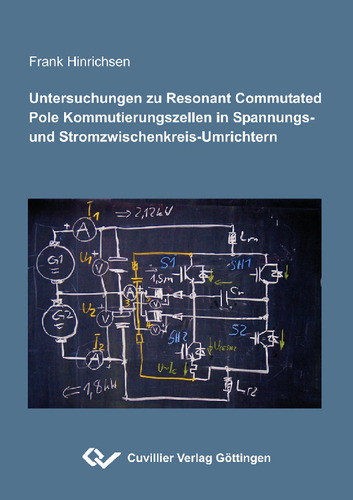
In recent years, the pulse inverter with Insulated Gate Bipolar Transistors (IGBTs) has assumed a prominent position in drive technology and in power supply. By means of resonant switching relief, so-called soft switching, the switching power losses occurring in the IGBTs can be reduced. This creates the possibility of reducing the cooling effort, increasing the switching frequency or improving the efficiency. The aim is usually a one-to-one replacement of the hard-switching inverter. The Auxiliary Resonant Commutated Pole Inverter (ARCPI) has emerged as a particularly promising candidate for achieving this goal; however, this topology also exhibits disadvantages such as symmetry problems at the capacitive divider of the DC link.
The work begins with an excursus into the technology of modern power semiconductors, taking into account the new base material silicon carbide. This is followed by an overview of the most important resonant converters and a proposal for their structured classification.
In total, four Resonant Commutated Pole commutation cells are investigated, first analytically and then experimentally. The starting point is the classical ARCPI with a voltage DC link. The results obtained with an optimised 1 MVA test converter for the motor-generator of a flywheel energy storage system are summarised. The current-source DC link ARCPI requires only two auxiliary switches for a three-phase inverter and is particularly attractive because of the possibility of stabilising the capacitive divider in a simple manner via the star point of the load. A three-phase test inverter is therefore built and measured.
With the aid of network theory, a new, so-called Resonant Commutated Twin Pole (RCTP) cell is derived from the ARCP commutation cell. Its operating principle is verified in a single-phase setup with a current DC link. The more promising RCTP cell with a voltage DC link is investigated in a three-phase inverter whose phases were realised in different technologies. The losses under hard and soft switching, with and without silicon carbide diodes, are directly compared with one another. An assessment of the new concept and an outlook on possible implementations conclude the work.
| ISBN-13 (Printausgabe) | 3867275491 |
| ISBN-13 (Hard Copy) | 9783867275491 |
| ISBN-13 (eBook) | 9783736925496 |
| Final Book Format | A5 |
| Language | German |
| Page Number | 192 |
| Edition | 1 |
| Volume | 0 |
| Publication Place | Göttingen |
| Place of Dissertation | Braunschweig |
| Publication Date | 2008-03-12 |
| General Categorization | Dissertation |
| Departments |
Electrical engineering
|


