
Cuvillier Verlag GmbH



| Departments | |
|---|---|
| Book Series (99) |
1415
|
| Nachhaltigkeit |
3
|
| Gesundheitswesen |
3
|
| Humanities |
2412
|
| Natural Sciences |
5430
|
| Engineering |
1821
|
| Engineering | 292 |
| Mechanical and process engineering | 872 |
| Electrical engineering | 700 |
| Mining and metallurgy | 30 |
| Architecture and civil engineering | 76 |
| Common |
97
|
|
Leitlinien Unfallchirurgie
5. Auflage bestellen |
|
Advanced Search
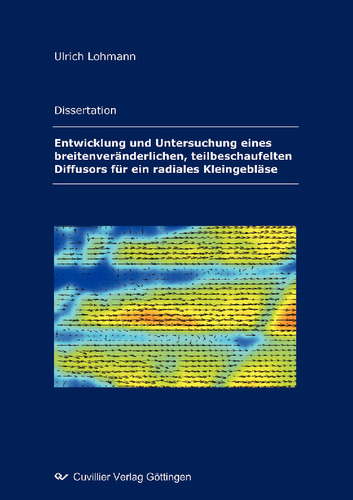
Entwicklung und Untersuchung eines breitenveränderlichen, teilbeschaufelten Diffusors für ein radiales Kleingebläse (English shop)
Ulrich Lohmann (Author)Preview
Table of Contents, Datei (39 KB)
Preface, Datei (19 KB)
Extract, Datei (200 KB)
This work presents the development of an adaptable diffuser for small blowers which achieves a wide operating map at high deceleration ratios and hence an increased overall pressure ratio. Starting from the vaneless diffuser with variable width, the partially vaned diffuser with variable width was developed.
In addition to the general energetic measurement techniques, extensive investigations of the diffuser were carried out during the development using Particle Image Velocimetry (PIV), with which entire flow fields can be recorded simultaneously and subsequently evaluated. Thus the unusual blade angle of the diffuser of 48°, as well as the ratio of the vaned to the vaneless diffuser diameter, result from the PIV investigations of the vaneless diffuser.
The installation of vanes in the outer part of the diffuser effectively suppresses the early backflows and, through better flow guidance, leads to a calming of the flow and hence to a higher pressure rise with simultaneously increased volume flow. In addition, the installation of the vanes brings about a marked increase in the maximum overall system efficiency by 8 percentage points to 48 %. This lies clearly above the level of the blower whose motor and impeller were used. (The original blower, with an already slightly modified diffuser, achieves an overall system efficiency of 29.5 % on the same test rig.)
The partially vaned diffuser with adjustable width can thus contribute to a substantial extension of the operating map. As the evaluations show, the surge limit can be shifted to extremely low volume flows. This is of particular importance for small blowers and compressors, since they possess only a severely restricted operating map. Through the adaptation to the flow, diffusers with a higher deceleration ratio can also be employed, which leads to a higher pressure rise. PIV was able to represent the flow in the diffuser well. The ability of PIV to visualise unsteady processes is an advantage of this system over all other non-intrusive measurement techniques. Thus flow separations and backflows can be identified in the section under consideration without having to search for them specifically with probe techniques. Moreover, the flow behaviour in the diffuser, in particular the efficiency-reducing profile distortions, could be measured and represented. The installation of the vanes, however, is also associated with an almost total shadowing of the vaneless part of the diffuser lying optically behind the guide vanes, which does not permit observation of the impeller outflow with PIV in the test set-up used. In addition, the surge limit could be determined by observing the particle behaviour. The PIV evaluations furthermore supported the thesis that the cells of the rotating stall initially extend from the outside upstream into the diffuser. The outer diffuser regions are thus decisive for the surge behaviour. A disadvantage of PIV is its low temporal resolution. This problem will be solved in the coming years by the further development of digital high-speed cameras.
Owing to the subdivision into a vaneless and a vaned partial diffuser, which became necessary for the width adjustment, the question additionally arises at which radius ratio the transition from the vaneless to the vaned part of the diffuser should take place. The blade angle depends on this, as does the necessity of being able to adapt the diffuser to the flow angle. In the case of this diffuser these parameters were determined with the aid of PIV in such a way that only the smallest possible adaptation of the blade angle by means of the width adjustment should be necessary. A widening of the diffuser should remain restricted to high volume flows. It remains to be clarified whether this also applies to diffusers with differing radius ratios for the partial diffusers as well as for the overall diffuser.
| ISBN-13 (Printausgabe) | 3867274908 |
| ISBN-13 (Hard Copy) | 9783867274906 |
| ISBN-13 (eBook) | 9783736924901 |
| Final Book Format | A5 |
| Language | German |
| Page Number | 152 |
| Edition | 1 |
| Volume | 0 |
| Publication Place | Göttingen |
| Place of Dissertation | Duisburg-Essen |
| Publication Date | 2008-01-18 |
| General Categorization | Dissertation |
| Departments |
Mechanical and process engineering
|
| Keywords | PIV, rotating stall. |


