
Cuvillier Verlag GmbH



| Departments | |
|---|---|
| Book Series (99) |
1415
|
| Nachhaltigkeit |
3
|
| Gesundheitswesen |
3
|
| Humanities |
2410
|
| Natural Sciences |
5428
|
| Mathematics | 229 |
| Informatics | 320 |
| Physics | 982 |
| Chemistry | 1371 |
| Geosciences | 131 |
| Human medicine | 246 |
| Stomatology | 10 |
| Veterinary medicine | 112 |
| Pharmacy | 147 |
| Biology | 837 |
| Biochemistry, molecular biology, gene technology | 121 |
| Biophysics | 25 |
| Domestic and nutritional science | 45 |
| Agricultural science | 1005 |
| Forest science | 201 |
| Horticultural science | 20 |
| Environmental research, ecology and landscape conservation | 148 |
| Engineering |
1821
|
| Common |
97
|
|
Leitlinien Unfallchirurgie
5. Auflage bestellen |
|
Advanced Search
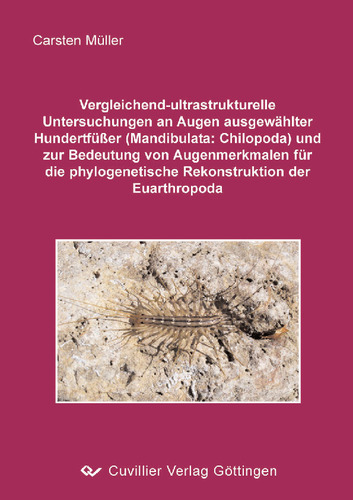
Vergleichend-ultrastrukturelle Untersuchungen an Augen ausgewählter Hundertfüßer (Mandibulata: Chilopoda) und zur Bedeutung von Augenmerkmalen für die phylogenetische Rekonstruktion der Euarthropoda (English shop)
Carsten Müller (Author)Preview
Table of Contents, Datei (33 KB)
Extract, Datei (83 KB)
Eyes are among the most impressive and important sensory organs in the animal kingdom. In addition to a diffuse dermal light sense, the most diverse types of simple pit eyes, lens eyes and compound eyes have evolved. Compound eyes in particular, and their optical units, the so-called ommatidia, play an important role in clarifying unresolved phylogenetic relationships within the higher arthropods (Euarthropoda). Although the evaluation of ommatidial characters has already occupied numerous phylogeneticists, the analyses have not led to a satisfactory result owing to insufficient knowledge of the structure of the eyes in important subgroups of the Euarthropoda. One such subgroup, poorly investigated in this respect to date yet holding a key phylogenetic position, is that of the centipedes (Chilopoda). On the basis of electron microscopic, histological and developmental studies it has now been shown that the most basal of all chilopod subgroups, the house centipedes (Scutigeromorpha), possess compound eyes whose ommatidia are very similar, both structurally and in terms of their development, to the ommatidia of crustaceans and insects. The presumed common origin of the compound eyes and their ommatidia now supports the assumption that insects, crustaceans and the next higher relationship group of the centipedes, the millipedes or diplopods (Myriapoda), form a monophyletic lineage (Mandibulata). The unicorneal ocelli (lateral ocelli) of the remaining chilopod subgroups deviate considerably from the structure of the ommatidia of the Scutigeromorpha. For the first time, a comparative ultrastructural study has been able to show that the eyes of the Lithobiomorpha, Scolopendromorpha and Craterostigmomorpha are indeed highly complex in design, but are composed of mutually homologous cell types, so that with regard to the origin of the lateral ocelli a single evolutionary event in the sister group of the Scutigeromorpha, the Pleurostigmophora, must be assumed. The present doctoral thesis is based on a synthesis of eight original publications (five of them as first author) and one review article.
| ISBN-13 (Printausgabe) | 3867274843 |
| ISBN-13 (Hard Copy) | 9783867274845 |
| ISBN-13 (eBook) | 9783736924840 |
| Language | German |
| Page Number | 276 |
| Edition | 1 |
| Volume | 0 |
| Publication Place | Göttingen |
| Place of Dissertation | Rostock |
| Publication Date | 2008-01-18 |
| General Categorization | Dissertation |
| Departments |
Biology
|


