
Cuvillier Verlag GmbH



| Departments | |
|---|---|
| Book Series (99) |
1415
|
| Nachhaltigkeit |
3
|
| Gesundheitswesen |
3
|
| Humanities |
2412
|
| Natural Sciences |
5430
|
| Mathematics | 230 |
| Informatics | 320 |
| Physics | 982 |
| Chemistry | 1371 |
| Geosciences | 131 |
| Human medicine | 246 |
| Stomatology | 10 |
| Veterinary medicine | 112 |
| Pharmacy | 147 |
| Biology | 837 |
| Biochemistry, molecular biology, gene technology | 121 |
| Biophysics | 25 |
| Domestic and nutritional science | 45 |
| Agricultural science | 1006 |
| Forest science | 201 |
| Horticultural science | 20 |
| Environmental research, ecology and landscape conservation | 149 |
| Engineering |
1821
|
| Common |
97
|
|
Leitlinien Unfallchirurgie
5. Auflage bestellen |
|
Advanced Search
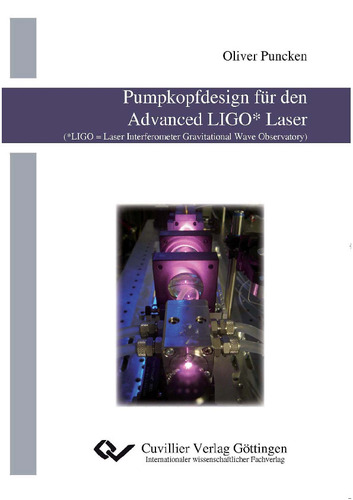
Pumpkopfdesign für den Advanced LIGO* Laser (*LIGO = Laser Interferometer Gravitational Wave Observatory) (English shop)
Oliver Puncken (Author)Preview
Table of Contents, Datei (30 KB)
Extract, Datei (540 KB)
High continuous-wave laser powers combined with good beam quality, narrow linewidths and low power and frequency noise are the requirements placed on laser systems intended for use in gravitational wave detectors operating on the principle of a Michelson interferometer. This thesis presents investigations by which the laser concept for the gravitational wave detector LIGO (Laser Interferometer Gravitational-Wave Observatory) was further developed. In its current expansion stage, the LIGO laser system is to be supplemented by an injection-locked high-power Nd:YAG oscillator, by means of which the laser power is to be scaled from 35 W to 165 W. The complexity of this oscillator permits only limited detailed investigation of its limitations in output power and beam profile. The system was therefore greatly simplified for the experiments presented in this work, while still allowing conclusions to be drawn regarding the LIGO laser system. An asymmetric standing-wave resonator is used, consisting of two opposing, longitudinally pumped Nd:YAG crystals. Between the crystals there is a birefringence compensation consisting of a 4f imaging system and a 90° quartz rotator. The influence of changes in the resonator geometry, in the pump light distribution within the laser medium and in the laser medium itself on the laser behaviour are considered separately. The concept of dynamically stable resonators allows selection of the transverse fundamental mode through the choice of the optimal resonator arm lengths. This choice is influenced by thermo-optical effects, which are characterised in this work using various methods. By means of the pump light distribution in the laser crystal, the onset of oscillation of different modes can be controlled and the efficiency optimised. With very good beam quality of the pump light, however, thermo-optical effects may be amplified by the concentration of the pump light near the crystal axis. It is investigated how efficiency, beam quality and output power depend on the pump light distribution in the laser crystal. Various possibilities for characterising Nd:YAG crystals with respect to their doping are presented. With the aim of proposing a crystal type that can be used as efficiently as possible, different crystal designs are investigated. The starting point is Nd:YAG crystals doped at 0.1 at.\%, designed for a double pass of the pump light. For comparison, crystals consisting of segments of different doping levels, and thus exhibiting lower longitudinal temperature gradients, are evaluated. More highly doped crystals pumped away from the Nd:YAG absorption maximum offer advantages with regard to more reproducible crystal quality. With the doping, however, the fractions of the pump light converted into heat, fluorescence and stimulated emission change. This relationship is analysed within the framework of this thesis. The depolarisation of linearly polarised laser radiation can be reduced in pumped Nd:YAG crystals cut in the 110 or 100 direction. Completely dispensing with birefringence compensation, however, leads to poorer results than the use of crystals cut in the usual 111 direction with birefringence compensation. The investigations carried out in this work have influenced the development and the understanding of the LIGO oscillator, so that a mature laser system could be integrated into the American gravitational wave detectors.
| ISBN-13 (Printausgabe) | 3869559675 |
| ISBN-13 (Hard Copy) | 9783869559674 |
| ISBN-13 (eBook) | 9783736939677 |
| Final Book Format | A5 |
| Language | German |
| Page Number | 161 |
| Lamination of Cover | matt |
| Edition | 1 Aufl. |
| Volume | 0 |
| Publication Place | Göttingen |
| Place of Dissertation | Hannover |
| Publication Date | 2011-12-13 |
| General Categorization | Dissertation |
| Departments |
Physics
|


