
Cuvillier Verlag GmbH



| Departments | |
|---|---|
| Book Series (99) |
1415
|
| Nachhaltigkeit |
3
|
| Gesundheitswesen |
3
|
| Humanities |
2411
|
| Natural Sciences |
5430
|
| Mathematics | 230 |
| Informatics | 320 |
| Physics | 982 |
| Chemistry | 1371 |
| Geosciences | 131 |
| Human medicine | 246 |
| Stomatology | 10 |
| Veterinary medicine | 112 |
| Pharmacy | 147 |
| Biology | 837 |
| Biochemistry, molecular biology, gene technology | 121 |
| Biophysics | 25 |
| Domestic and nutritional science | 45 |
| Agricultural science | 1006 |
| Forest science | 201 |
| Horticultural science | 20 |
| Environmental research, ecology and landscape conservation | 149 |
| Engineering |
1821
|
| Common |
97
|
|
Leitlinien Unfallchirurgie
5. Auflage bestellen |
|
Advanced Search
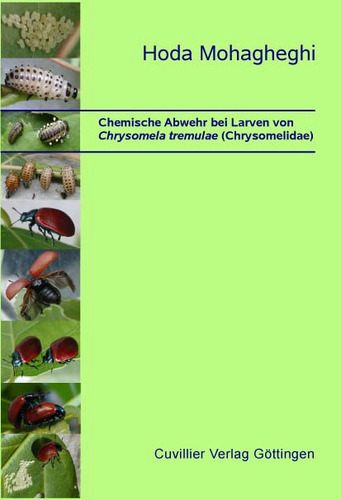
Chemische Abwehr bei Larven von Chrysomela tremulae (Chrysomelidae) (English shop)
Hoda Mohagheghi (Author)Preview
Table of Contents, Datei (40 KB)
Extract, Datei (190 KB)
Leaf beetle (chrysomelid) larvae protect themselves against predators by means of chemical substances. Species of the subfamily Chrysomelina produce substances in defensive glands located in the meso- and metathorax as well as in the seven abdominal segments. Upon disturbance, the defensive secretion is pressed outwards, so that a droplet appears on the body surface of the larva. These volatile substances surround the larva like a cloud of scent, preventing contact with the predator.
Chemical analyses have identified three different defensive secretion compositions. Many larvae synthesise iridoid monoterpenes independently of their host plant. Most Chrysomela species and Phratora vitellinae use phenolic glucosides of the Salicaceae to form salicylaldehyde. The third group produces esters of isobutyric and 2-methylbutyric acid to deter predators.
C. tremulae feeds on Salicaceae and uses salicin from the host plant as a precursor for the formation of salicylaldehyde. Salicin is taken up into the defensive gland and hydrolysed by a β-glucosidase to salicyl alcohol, which is oxidised to salicylaldehyde by an extracellular oxidase, salicyl alcohol oxidase (SAO). The hydrogen peroxide thereby produced is detoxified by a catalase.
Previous studies have suggested that the autogenous strategy of the iridoid monoterpenes represents the ancestral pathway. From this, the host plant-dependent strategy evolved, which, owing to the use of plant precursors, is energetically more favourable than the autogenous strategy.
In order to reconstruct this phylogenetic development, the SAO was biochemically characterised in earlier work of our research group. In the present work we have identified a putative SAO-encoding cDNA from C. tremulae. A catalase and a β-glucosidase were also found.
| ISBN-13 (Printausgabe) | 3867272972 |
| ISBN-13 (Hard Copy) | 9783867272971 |
| ISBN-13 (eBook) | 9783736922976 |
| Final Book Format | A5 |
| Language | German |
| Page Number | 128 |
| Edition | 1 |
| Volume | 0 |
| Publication Place | Göttingen |
| Place of Dissertation | Braunschweig |
| Publication Date | 2007-07-19 |
| General Categorization | Dissertation |
| Departments |
Pharmacy
Biology |
| Keywords | Chrysomelid larvae, Chrysomelidae, chemical defence, *Chrysomela tremulae*. |


