
Cuvillier Verlag GmbH



| Departments | |
|---|---|
| Book Series (99) |
1415
|
| Nachhaltigkeit |
3
|
| Gesundheitswesen |
3
|
| Humanities |
2411
|
| Natural Sciences |
5429
|
| Mathematics | 230 |
| Informatics | 320 |
| Physics | 982 |
| Chemistry | 1371 |
| Geosciences | 131 |
| Human medicine | 246 |
| Stomatology | 10 |
| Veterinary medicine | 112 |
| Pharmacy | 147 |
| Biology | 837 |
| Biochemistry, molecular biology, gene technology | 121 |
| Biophysics | 25 |
| Domestic and nutritional science | 45 |
| Agricultural science | 1005 |
| Forest science | 201 |
| Horticultural science | 20 |
| Environmental research, ecology and landscape conservation | 148 |
| Engineering |
1821
|
| Common |
97
|
|
Leitlinien Unfallchirurgie
5. Auflage bestellen |
|
Advanced Search
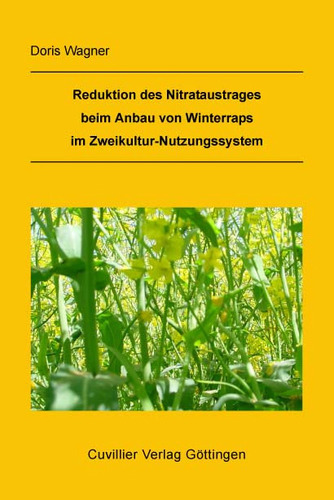
Reduktion des Nitrataustrages beim Anbau von Winterraps im Zweikultur-Nutzungssystem (English shop)
Doris Wagner (Author)Preview
Table of Contents, Datei (74 KB)
Extract, Datei (100 KB)
Oilseed rape is regarded as the most important oil crop in Germany, with the highest yields among oil plants. New varieties are suitable for the production of edible oil as well as for the extraction of biodiesel and, furthermore, for a wide range of technical applications. In recent decades, a continuous increase in the area under cultivation has been observed in oilseed rape production. In 2004, the largest area to date, 1.3 million ha and thus approx. 11% of the total arable land, was sown with winter oilseed rape. The cultivation of winter oilseed rape (Brassica napus L.) is not ecologically unproblematic, since high grain yields require considerable pesticide use and large amounts of nitrogen fertiliser. As a result of either incompletely absorbed nitrogen, premature leaf fall or harvest residues, considerable amounts of nitrate nitrogen at risk of leaching remain in the field after harvest. Although oilseed rape can remove high amounts of nitrogen of 200 kg N/ha and more from the soil, only a small proportion is removed from the field with the harvested grain. The largest part remains on the area with the leaf and straw mass and is mineralised to nitrate after the early harvest, combined with intensive tillage to control volunteer oilseed rape. Since these high amounts of nitrogen cannot be taken up by subsequently grown catch crops or by the winter wheat customary in the crop rotation, residual nitrate amounts of 100 kg N/ha and more usually remain. Large quantities of this are mineralised and nitrified in autumn and are subject to the risk of leaching into the groundwater. In this context, the value in arable soils that is considered tolerable with regard to groundwater pollution is often exceeded threefold after oilseed rape cultivation. In the double-cropping system, two crops are grown per growing season, both of which are harvested as whole plants before generative maturity at the time of the highest biomass yield (in winter oilseed rape at EC 85). After the harvest of the first crop, the second crop is sown directly into the stubble of the harvested plant. Wild plants or weeds growing up can be tolerated in this system, since they represent an additional biomass yield. Both harvests are ensiled and are thus available all year round and independently of the weather for energy use in a biogas plant. The permanent soil cover provides erosion protection and minimises the risk that nitrogen released by mineralisation can be transferred as nitrate into the groundwater. Through the whole-plant harvest of green oilseed rape, the entire above-ground bound nitrogen is removed, i.e. only few readily degradable plant components such as leaves, straw or pods remain. Remaining residual nitrogen amounts can be taken up by the unfertilised second crop. Biodiversity is made possible through the cultivation of any desired species and variety mixtures as well as the toleration of wild plants.
| ISBN-13 (Printausgabe) | 3867272794 |
| ISBN-13 (Hard Copy) | 9783867272797 |
| ISBN-13 (eBook) | 9783736922792 |
| Final Book Format | A5 |
| Language | German |
| Page Number | 148 |
| Edition | 1 |
| Volume | 0 |
| Publication Place | Göttingen |
| Place of Dissertation | Kassel |
| Publication Date | 2007-07-04 |
| General Categorization | Dissertation |
| Departments |
Agricultural science
|
| Keywords | Winter oilseed rape, dual-cropping system, nitrate leaching, biomass, grassland science. |


