
Cuvillier Verlag GmbH



| Departments | |
|---|---|
| Book Series (99) |
1415
|
| Nachhaltigkeit |
3
|
| Gesundheitswesen |
3
|
| Humanities |
2412
|
| Medienwissenschaften | 17 |
| Theology | 57 |
| Philosophy | 103 |
| Law | 430 |
| Economics | 863 |
| Social sciences | 423 |
| Sports science | 48 |
| Psychology | 233 |
| Educational science | 190 |
| History | 194 |
| Art | 111 |
| Cultural studies | 168 |
| Literary studies | 119 |
| Linguistics | 91 |
| Natural Sciences |
5430
|
| Engineering |
1821
|
| Common |
97
|
|
Leitlinien Unfallchirurgie
5. Auflage bestellen |
|
Advanced Search
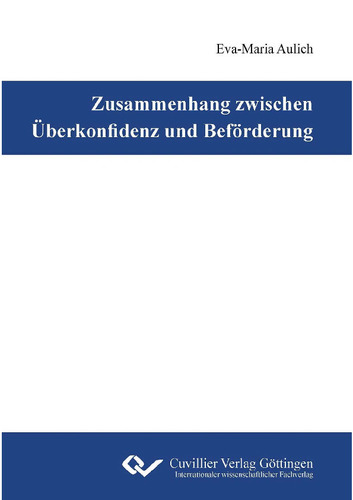
Zusammenhang zwischen Überkonfidenz und Beförderung (English shop)
Eva-Maria Aulich (Author)Preview
Table of Contents, Datei (31 KB)
Extract, Datei (86 KB)
People make important as well as less important decisions under uncertainty every day. In doing so, they frequently overestimate how well they are informed about the decision alternatives. This state, which describes an inappropriately high confidence in the accuracy of one’s own judgements, is termed overconfidence. Poor decisions can be a consequence of this overconfidence. From a company’s perspective, it is therefore of interest, on the one hand, to know in which situations the occurrence of overconfidence is particularly likely. On the other hand, it is equally crucial to know which corporate decisions in particular may be influenced by the overconfidence of the persons involved.
One situation that typically occurs regularly in hierarchically structured companies is promotion. On the one hand, promotions could be considered as a trigger of overconfidence; on the other hand, promotion decisions themselves could be influenced by the overconfidence of the promotion candidates.
The question of whether promotions change the extent of the overconfidence of those promoted has to date been examined neither theoretically nor empirically. Whether overconfident candidates are more likely to be promoted has so far been analysed exclusively theoretically – and has led to contradictory hypotheses. Ms Aulich’s dissertation closes these existing research gaps by addressing the relationship between the constructs of overconfidence and promotion. The relationship between the two constructs is considered from two directions of effect: in the first sub-study of the dissertation, the aim is to determine whether the overconfidence of promotion candidates affects their promotion prospects. The other two sub-studies focus on the effects of promotion decisions, or of the event of a promotion, on the overconfidence of those affected.
The methodological approach is characterised by the interplay of theoretical and empirical analysis. Each research question of the three sub-studies is first analysed theoretically. Hypotheses are derived from this analysis and subsequently tested empirically. The theoretical analyses are characterised by multidisciplinarity. Thus, in addition to economic theories, psychological and sociological approaches as well as findings from brain research are also included. The empirical analyses are based on a primary data collection. A longitudinal field experiment was used as the empirical analytical instrument.
| ISBN-13 (Printausgabe) | 3869559403 |
| ISBN-13 (Hard Copy) | 9783869559407 |
| ISBN-13 (eBook) | 9783736939400 |
| Final Book Format | A5 |
| Language | German |
| Page Number | 198 |
| Lamination of Cover | matt |
| Edition | 1 Aufl. |
| Volume | 0 |
| Publication Place | Göttingen |
| Place of Dissertation | Zürich |
| Publication Date | 2011-11-22 |
| General Categorization | Dissertation |
| Departments |
Economics
|


