
Cuvillier Verlag GmbH



| Departments | |
|---|---|
| Book Series (99) |
1418
|
| Nachhaltigkeit |
3
|
| Gesundheitswesen |
3
|
| Humanities |
2418
|
| Natural Sciences |
5433
|
| Engineering |
1825
|
| Engineering | 292 |
| Mechanical and process engineering | 875 |
| Electrical engineering | 701 |
| Mining and metallurgy | 30 |
| Architecture and civil engineering | 76 |
| Common |
97
|
|
Leitlinien Unfallchirurgie
5. Auflage bestellen |
|
Advanced Search
Potenziale variabler Einspritzsysteme für die Benzin-Direkteinspritzung (English shop)
Oliver Tremmel (Author)Preview
Table of Contents, Datei (25 KB)
Preface, Datei (25 KB)
Extract, Datei (180 KB)
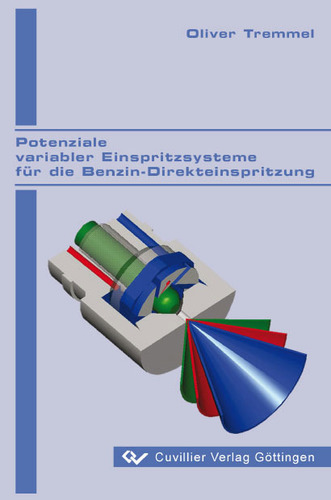
The injection nozzle is of central importance for implementing a spray-guided combustion process in passenger-car gasoline engines with direct injection. At present, outward-opening annular-gap nozzles (A-nozzles) are favoured for production applications with spray-guided stratified lean combustion processes. Since, according to the current state of the art, this injection nozzle concept is tied to a piezo-actuated nozzle needle, it represents a technically extremely complex and cost-intensive solution. In order to evaluate alternative solutions, this work investigates the potential of two variable injection systems for use in spray-guided combustion processes. The design of the research injection systems is oriented towards maximum utilisation of degrees of freedom in order to discuss injector functionalities that will be required in the future.
A variable swirl-based nozzle was developed whose characteristic properties can be altered during operation. The possibility of continuous adjustment makes it possible to compensate for back-pressure-dependent changes in the spray cone angle, such as those typically occurring with conventional swirl nozzles in production applications in passenger-car gasoline engines with direct injection. With the aid of fast-switching valves, the hydraulic properties and the spray properties of this nozzle can, for the first time, even be altered during an injection event. It is thus possible to adapt the spray shape to the requirements of engine operation. The functionality of this nozzle concept could be demonstrated under engine boundary conditions on a single-cylinder research engine, whereby the nozzle design must be adapted in order to optimise operation in the spray-guided combustion process.
Furthermore, a multi-hole nozzle with a piezo-actuated nozzle needle was operated at an injection pressure of up to 1000 bar. It was found that increasing the injection pressure as well as operating the nozzle needle at extremely small partial lifts intensify spray break-up due to cavitation effects and thus also intensify mixture formation. Investigations on transparent nozzles clearly confirm the increased formation of cavitation in the blind hole of the nozzle under needle-seat-throttled operation and at high injection pressures.
| ISBN-13 (Printausgabe) | 3867272468 |
| ISBN-13 (Hard Copy) | 9783867272469 |
| ISBN-13 (eBook) | 9783736922464 |
| Final Book Format | A5 |
| Language | German |
| Page Number | 148 |
| Lamination of Cover | glossy |
| Edition | 1 |
| Volume | 0 |
| Publication Place | Göttingen |
| Place of Dissertation | Hannover |
| Publication Date | 2007-06-04 |
| General Categorization | Dissertation |
| Departments |
Mechanical and process engineering
|
| Keywords | variable injection systems, gasoline direct injection, spray-guided combustion process |


