
Cuvillier Verlag GmbH



| Departments | |
|---|---|
| Book Series (99) |
1410
|
| Nachhaltigkeit |
3
|
| Gesundheitswesen |
3
|
| Humanities |
2401
|
| Medienwissenschaften | 16 |
| Theology | 57 |
| Philosophy | 103 |
| Law | 427 |
| Economics | 861 |
| Social sciences | 423 |
| Sports science | 48 |
| Psychology | 233 |
| Educational science | 190 |
| History | 190 |
| Art | 111 |
| Cultural studies | 167 |
| Literary studies | 117 |
| Linguistics | 90 |
| Natural Sciences |
5426
|
| Engineering |
1817
|
| Common |
97
|
|
Leitlinien Unfallchirurgie
5. Auflage bestellen |
|
Advanced Search
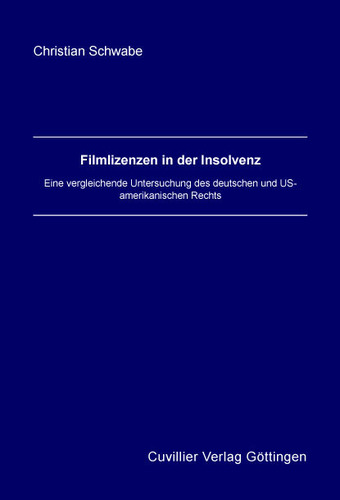
Filmlizenzen in der Insolvenz (English shop)
Eine vergleichende Untersuchung des deutschen und US-amerikanischen Rechts
Christian Schwabe (Author)Preview
Table of Contents, Datei (78 KB)
Preface, Datei (49 KB)
Extract, Datei (85 KB)
Vor dem Hintergrund der weltweit prosperierenden Vermarktung immaterieller Güter stellt sich insbesondere die Frage nach der rechtlichen Behandlung von Filmlizenzen in der Insolvenz. Wie kaum eine andere Sparte der Unterhaltungsindustrie ist das Filmwesen naturgemäß mit einem hohen wirtschaftlichen Aufwand und daher mit entsprechenden Risiken behaftet. Während beim Vertrieb und dem Handel mit urheberrechtlichen Nutzungsrechten ein hoher Grad an Internationalität erreicht wird, ist es nach wie vor Aufgabe des nationalen Insolvenzrechts ungeeignete oder erfolglose Wettbewerber in staatlich vorgegebener Ordnung aus dem Markt auszuscheiden.
In diesem Zusammenhang unternimmt die Arbeit einen Vergleich der Rechtsordnungen der Bundesrepublik Deutschland und der Vereinigten Staaten von Amerika. Im Zentrum der Betrachtung stehen die auch im internationalen Geschäftsverkehr zentralen Fragen nach der Zuordnung der Filmlizenzen als Immaterialgüterrecht in der Insolvenz und insbesondere der Insolvenzfestigkeit der betreffenden Lizenzverträge.
Nach kurzer historischer Einführung stellt der Verfasser im ersten Kapitel zunächst die nationalen und US-amerikanischen Rechtsgrundlagen der Lizenz dar und erörtert im zweiten Kapitel rechtsvergleichend die zentralen Fragen der Zugehörigkeit von Lizenzen zur Insolvenzmasse sowie des Insolvenzverwalterwahlrechts. Im dritten Kapitel werden die praktisch äußerst relevanten Fragen im Hinblick auf bestehende Lösungsmöglichkeiten von Lizenzgebern in der Insolvenz des Lizenznehmers erörtert. Das vierte Kapitel – als Herzstück der Arbeit – schließlich befasst sich mit den Rechtsfolgen der Insolvenz auf bestehende Lizenzverhältnisse und zeigt dabei sowohl Risiken als auch Sicherungsmöglichkeiten auf. In diesem Zusammenhang stellt sich die äußerst relevante und vieldiskutierten Frage, ob im Urheberrecht das Abstraktionsprinzip nur eingeschränkt gelten soll. Der Verfasser zeichnet diese Problematik anhand einer Überprüfung der umstrittenen Analogie zu § 9 VerlG nach und zeigt strukturelle Unterschiede am Vergleich zum US-amerikanischen Recht auf.
| ISBN-13 (Printausgabe) | 3867272492 |
| ISBN-13 (Hard Copy) | 9783867272490 |
| ISBN-13 (eBook) | 9783736922495 |
| Final Book Format | A5 |
| Language | German |
| Page Number | 338 |
| Edition | 1 |
| Volume | 0 |
| Publication Place | Göttingen |
| Place of Dissertation | Göttingen |
| Publication Date | 2007-06-04 |
| General Categorization | Dissertation |
| Departments |
Law
|


